

Quick Answer
Builder gel on natural nails suits people whose nails are healthy, moderately flexible, not peeling, and not oily at the root. Keep the free edge at or under 50 percent of your nail bed length at a fresh set, cap any extension at 2 to 3 mm past the free edge, apply in thin layers under a proper LED lamp, and remove by soak-off, never by peeling. If your nails are peeling, splitting at the tip, discolored, or recovering from damage, wait before coating.
If you are reading your own nails at the kitchen table before opening a bottle, you are already ahead of most first-time home users. The correct order for every builder gel decision is the same at home as it is in a salon: natural nail first, system second, product third. Almost every disappointing home set traces back to reversing that order, picking a shape or a product and then trying to force the natural nail to fit it.
This guide walks through what to look at on your own hand, the two length rules that decide whether a coating holds for four weeks or breaks in four days, the nail profiles builder gel suits well, the ones it does not, and the three things that matter more than which bottle you buy first.
Four Things to Check on Your Own Nails Before Builder Gel
Before any product goes on, four things on the natural nail decide the whole set. Run through them in order. Check 1 has veto power. Checks 2 through 4 decide how to coat if the first check passes.
- Nail health. Look for peeling at the tip, splitting at the sides, white or green discoloration, a soft or spongy plate, or ridges you did not have a month ago. Any of these is a reason to wait, not a reason to cover. A coating applied over a compromised plate traps the problem under acrylic chemistry.
- Thickness and flexibility. Press lightly on the free edge. A healthy natural plate is thin enough to flex slightly and spring back. A plate that feels papery and stays bent flat is undernourished. A plate that feels like a stiff board is often heavily filed from previous sets and needs recovery time.
- Nail bed length. Look at the pink part that is still attached to the finger. That is your nail bed. The free edge, the white or clear part past the fingertip, should start where that pink stops. Nail bed length is anatomy. Two friends asking for the same look can get different millimeters because their beds are different lengths.
- Oiliness. Oily plates reject gel. If your fingertips always look a little shiny ten minutes after you wash your hands, your plate runs on the oilier side. That does not disqualify you, but it does change the prep step.
If check 1 flagged anything, close the bottle and skip to the "Four Situations to Wait" section below. If checks 2 through 4 are clear, keep reading.

The 50 Percent Rule: How Much Length Is Safe for Builder Gel on Natural Nails
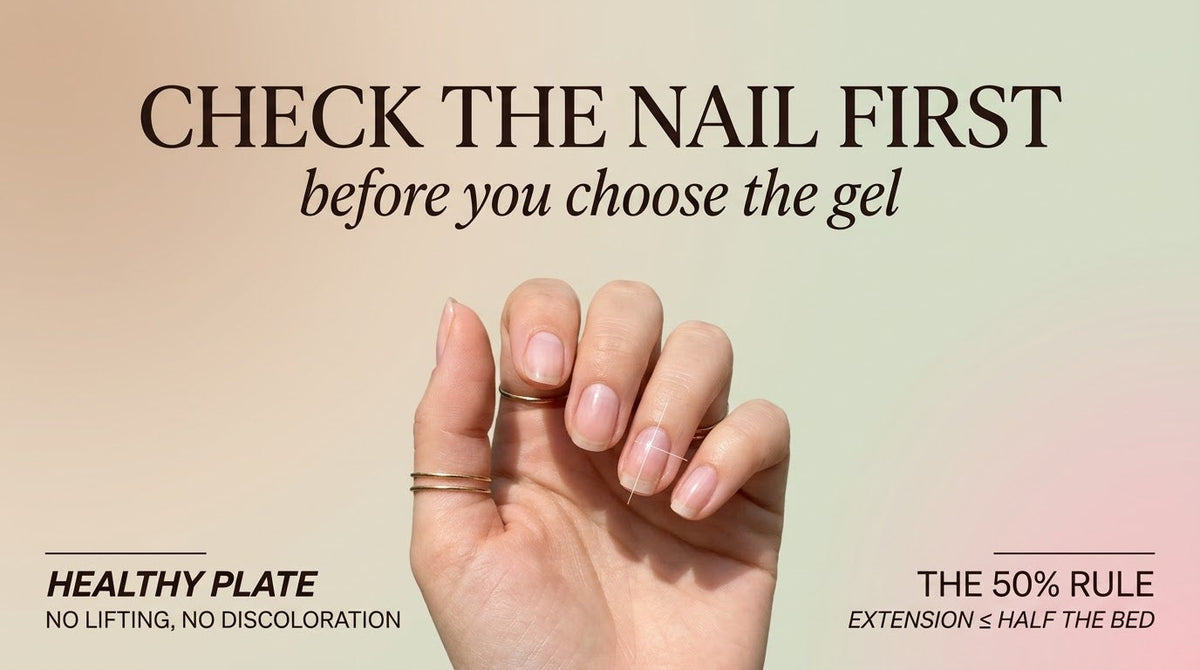
This is the length rule that decides more home-set outcomes than any specific product. At a fresh set, the free edge should be at most 50 percent of the length of the nail bed. That means if your nail bed is 12 mm long, the white tip past your finger should be no more than 6 mm.
Why 50 percent, and not a longer number
Natural nail growth over a four to six week cycle gradually pushes the free-edge-to-bed ratio higher. By the time you are due for a refresh at home, the ratio has drifted up. A structural coating starts to feel less stable when the free edge gets proportionally long compared to the base holding it, because the lever past the fingertip is working against a short anchor.
A fresh set at 50 percent means your refresh point arrives at a proportion the coating can still hold comfortably. A fresh set at the full length of your bed means the refresh point arrives past the comfortable range, and small chips and lifts show up in the days before you were planning to redo them. Cutting back at the start is the single easiest change that extends wear at the end.
Builder Gel's Own Ceiling: 2 to 3 mm Past the Free Edge
There is a second limit that runs alongside the 50 percent rule. Builder gel as a material is formulated to cap, overlay, and extend by a short amount. Any extension past the free edge is best kept inside a 2 to 3 mm range. Past that range, the material is carrying mass it was not designed for, and the usual failure is a break at the base of the projection within the first week.
Past the 3 mm ceiling, builder gel on natural nails is no longer the right call. Length beyond that range belongs to full-cover soft gel tips, hard gel, or acrylic. If you want a dramatic length jump at home, a full-cover tip pre-formed to your nail size is a safer carrier than asking builder gel to do extension work. Honest cross-shop: the SNS Nails catalog includes soft-gel full-cover tip options (LDS Full Cover is one example) that take over the length work when builder gel on natural nails is at its ceiling.

Six Nail Profiles Builder Gel on Natural Nails Suits Well
Builder gel suits certain nails better than others. The category is not defined by what you want done; it is defined by what your nail is actually doing. Six profiles get more benefit from builder gel on natural nails than from other systems.
- Healthy, moderately thick plates that chip regular polish within 48 hours. A thin structural overlay adds the stiffness regular polish cannot provide. This is the clearest fit.
- Flat or spoon-shaped plates that want a mild apex. Builder gel can self-level a modest arch in the center of the nail without extensions, improving the side profile.
- Short bitten nails growing out. A thin cap with no added length protects the regrowth phase. Keep the free edge under the 50 percent rule even as the nail grows.
- Nails that split at the free edge within a week. A sealed free-edge wraps the vulnerable corner that splits first.
- People who type, text, cook, and do dishes. Daily impact needs a thin, flexible coating. Builder gel bends with the plate rather than popping off like a brittle acrylic.
- Anyone who wants three to four weeks between refresh sessions. Done right and kept inside both length rules, builder gel on natural nails is a three-to-four-week coating for most home users.

"Weak Nails Need Thicker Builder Gel on Natural Nails" and Why That Backfires
The instinct is understandable. A weak nail feels like it needs more support, and a thicker coating feels like more support. Both halves of that reasoning are wrong, and the mistake creates a specific failure pattern at home: applied thick, feels warm during cure, lifts at the cuticle within three days, breaks at the base within the week.
It backfires two ways
First, a weak plate still flexes with your finger. A heavy, inflexible layer on top of a flexing plate creates stress at the base of the coating, and that stress shears the coating off at the spot it was supposed to protect. A thin, flexible layer bends with the plate; a thick, rigid layer fights it.
Second, thin plates transmit cure heat more strongly. A thick layer of gel releases more heat during cure than a thin one, and a thin plate underneath passes that heat straight through to the sensitive tissue below. The sensation at home is a burning spike under the lamp. That is not nerves; that is a real physical response to layer thickness.
The correct approach with a weak plate
- Reinforce first with a cushioning base. A thinner cushioning foundation (rubber base is one option) gives the structural coat something to bond to that is not the flexing plate directly.
- Thin per layer, multiple layers. Correct structure is thin per layer, built up to the specification total. Thin per layer is not the same as thin overall.
- No extensions on your first attempt. If you are new to builder gel on natural nails and your plate is on the weak side, do an overlay with no length added on the first set. Let the plate grow out under protection for two or three cycles before attempting an extension.
Four Situations to Wait Before Using Builder Gel on Natural Nails
There are four specific conditions where the correct answer to "should I apply builder gel today" is "not right now." A coating applied under these conditions creates problems the coating itself cannot solve.
- Visible plate damage from a previous set. Thin, flaking, or crumbling patches need weeks of free-edge-only maintenance (file smooth, keep oiled, no coating). Covering these traps moisture and sensitizes the plate.
- Unusual discoloration. Green, black, yellow, or white patches you cannot explain belong to a dermatology consultation first. Do not cover. Do not file. Do not name a condition yourself.
- Active skin irritation at the cuticle or sidewalls. Red, swollen, or weeping cuticle tissue means any uncured product that contacts that skin is sitting on an already-inflamed surface, which is the main path to developing a long-term sensitization reaction.
- Within 48 hours of removal. Fresh off a soak-off, the plate is soft and the top layer is slightly dehydrated. Give it one to two days of oiling and resting before layering on a new coating.

Doing Builder Gel on Natural Nails at Home: Three Rules
At home, there is no professional intermediary catching warning signs or correcting technique in real time. Three rules matter more than which bottle you buy first.
- Read your own nails first. Run the four checks from the first section above. If check 1 raises any concern, close the bottle and come back next week. This matters more at home than anywhere else because nobody else is reading your hands for you.
- The lamp is a technical requirement, not an accessory. A thick gel layer that your lamp cannot reach fully cures at the surface and stays soft underneath. Uncured product touching your skin is one of the paths to sensitization. A starter-kit lamp from an unfamiliar brand is a real variable; match the lamp to the gel maker's wattage and timing specifications. If you cannot invest in an appropriate lamp, do not attempt a home set.
- Never peel or pick off at home. The single most damaging home mistake with builder gel on natural nails is peeling or prying the coating off with a nail or a tool. The natural plate underneath is roughly 0.3 mm thick, and peeling pulls a layer of that plate off with the gel. The damage lasts months because that is how long it takes for the affected layer to grow out. Removal is a proper acetone soak-off, not a shortcut.

Builder Gel on Natural Nails vs Dip Powder: The SNS Catalog Cross-Shop
If builder gel on natural nails is not matching your profile, the SNS Nails catalog has a second DIY structural system worth looking at: dip powder. Honest comparison for home users:
- Builder gel. Flexible, bends with the plate, a thin apex is easy, uses a lamp. Suits people who type, cook, and want a natural-feeling coating. Capped at 2 to 3 mm extension.
- Dip powder. Harder finish, no lamp required for the structural build, slightly thicker typical finish. Suits people who want impact resistance (slamming a drawer, carrying heavy bags) more than flex. Also 2 to 3 mm extension range at home for honest wear.
Neither is "better." They solve different problems. If your plate is thin and flexes, builder gel on natural nails is usually the more comfortable match. If your plate is already thick and your lifestyle is impact-heavy, dip is worth testing. Both live on SNS.
Quick Reference Table: Your Nail Condition → Your Builder Gel on Natural Nails Call
| Your natural nail condition | Your call |
|---|---|
| Healthy, mid-thickness, non-oily | Full builder gel set, extend 0 to 3 mm, follow 50% rule |
| Healthy but oily at root | Add a dehydrator step, thin cushion, thin structural layers |
| Thin, flexible, peeling tip | Overlay only, no extension, cushion base, thin per layer |
| Short bitten, growing out | Thin protective overlay, re-evaluate at every refresh |
| Visible damage, unusual color, active cuticle irritation | WAIT. Dermatology consult if color is unusual. |
| Want length past 3 mm extension | Switch system: full-cover soft gel tips, not builder gel |
FAQ About Builder Gel on Natural Nails
What are the four things to check before builder gel on natural nails?
Nail health (veto power), thickness and flexibility, nail bed length, and oiliness. Check 1 decides whether to coat at all. Checks 2 through 4 decide how to coat if the first check passes.
What is the 50 percent rule for builder gel on natural nails?
At a fresh set, the free edge should be no more than 50 percent of the length of the nail bed. Natural growth pushes that ratio higher over the weeks between refreshes. Starting at 50 percent means the refresh point arrives at a proportion the coating can still hold.
How far past my free edge can I extend with builder gel on natural nails?
2 to 3 mm is the comfortable working range of the material at home. Past that, builder gel is no longer the right product for the length work. A full-cover soft gel tip is a safer carrier for anything longer.
Why does a thicker layer of builder gel on natural nails backfire on weak plates?
Two reasons. A weak plate flexes, and a thick inflexible layer cannot flex with it, so the layer shears at the base. Thin plates also transmit cure heat more strongly, so a thick layer feels like a burning spike under the lamp. Correct approach is a cushion base, then thin per layer with multiple layers.
Can I pick builder gel off at home to remove it?
No. Peeling pulls a layer of your natural plate off with the gel. The plate underneath is about 0.3 mm thick and takes months to fully regrow. Always soak off in acetone.
Is builder gel on natural nails or dip powder a better DIY pick?
Depends on your plate and lifestyle. Builder gel is flexible, bends with the plate, needs a lamp, and feels natural. Dip is harder, impact resistant, and does not need a lamp for the structure. SNS carries both. Pick by what your plate is doing, not by what looks easier in a video.
Related Reading on SNS
- Builder Gel Cost at Home vs Salon: The Real Breakeven Math
- Builder Gel vs Dip Powder: An Honest SNS Cross-Shop
- Peel-Off Base Coat with Builder Gel: Will It Work at Home?
- How to Remove Builder Gel at Home Without Damaging Your Nails
- SNS DIY Tool Kit: Files, Brushes, and E-File Safety
Sources
- NAILS Magazine. "Gel chemistry and cure heat on the natural plate." nailsmag.com
- American Academy of Dermatology Association. "Nail plate anatomy and thickness in adults." aad.org
About the author
Alan Nguyen writes the DIY nail chemistry series for SNS Nails. His focus is translating salon techniques into honest home-use rules for readers who are doing their own nails between professional visits.
Reviewed by
Thao Vu, licensed nail technician, Westminster, CA. 12 years of professional overlay and extension work with builder gel and soft-gel tip systems.
Michelle Tran, DIY nail content educator, Houston, TX. 8 years teaching home builder gel and dip technique.


