

Alan is the founder of SNS Nails and writes the SNS Nails Education cluster on gel system selection and DIY-safe application sequences.
Thao Vu is a California-licensed nail technician and SNS-certified brand educator with 10+ years of practice and 300+ nail techs trained on SNS curriculum. Michelle has operated her SNS salon in Houston since 2019, serving 200+ clients a month across Gel X, builder gel, and SNS Nutri-Plus dip powder systems.
Quick Answer: Gel X vs Builder Gel in One Paragraph
Read the natural nail, not the preference. Five features of the plate decide between Gel X and builder gel: C-curve, sidewall width, nail bed length, oiliness, and whether the plate is bitten or warped. A flat plate under a curved Gel X tip creates a geometric air gap on every finger. Builder gel ceiling is 2-3mm of length past the free edge. If length and shape conflict with plate shape, stack a soft gel tip under builder gel. The same read also predicts whether SNS Nutri-Plus dip powder fits as an alternative structural overlay.
Gel x vs builder gel is one of the most common pre-set debates when someone wants length or structure on their nails.
The debate usually gets settled by asking the wrong question. Clients get asked which one they prefer, and DIY users ask the same question of themselves. Neither of those readings is useful, because the answer sits in facts about the natural nail that are not visible without a one-minute structural read.
This SNS DIY guide covers the five-feature read that decides the case, the two length rules that limit each system, the signature failure modes for both, the one case where you can use Gel X and builder gel together, and how SNS Nutri-Plus dip powder fits into the same decision frame. Written for techs serving clients and for DIY users reading their own plate.
Why Asking Which System You Prefer Is the Wrong Gel X vs Builder Gel Question
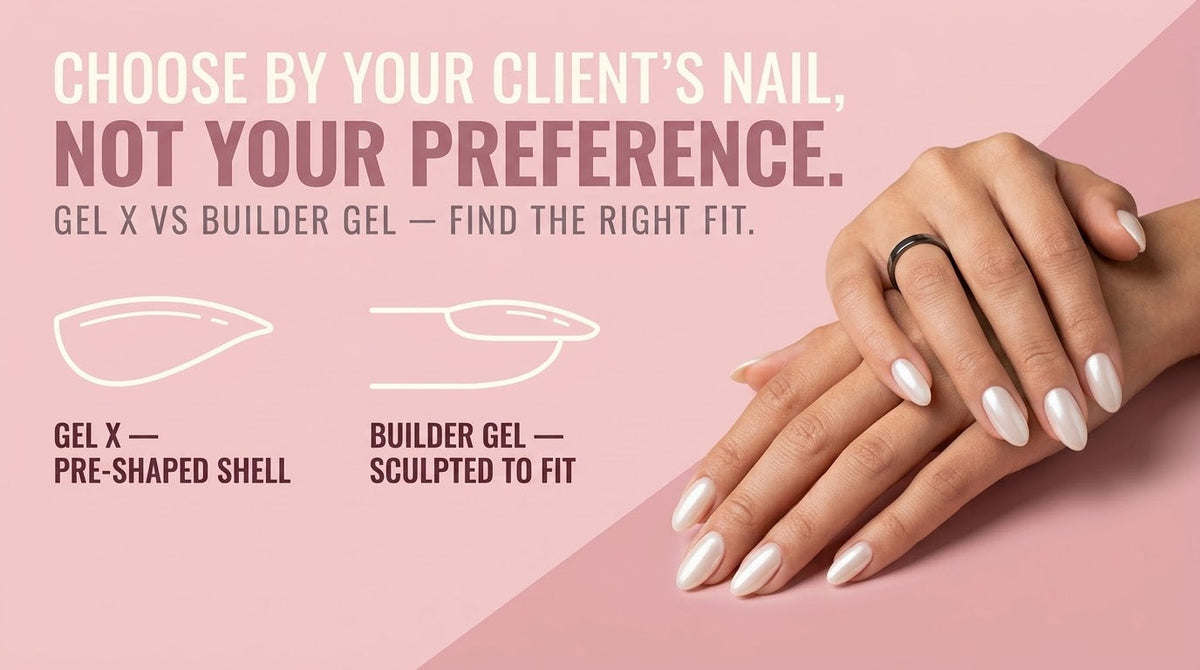
Gel X is a shape-matching system. It works when the pre-formed tip shape matches the client natural nail shape.
Builder gel is a shape-creating system. It works because the gel follows whatever shape the plate already has. Every other difference between the two systems is a downstream consequence of this one.
A client (or a DIY user) cannot answer which system fits because the answer sits in facts about the plate. How curved is the plate in profile view? How wide is it from sidewall to sidewall? How much length exists from the cuticle to the free edge? Is the surface oily? Is the plate bitten, warped, or short? Every one of these changes the decision, and every one is a visual read done BEFORE the box of tips or the bottle of gel is opened.

Five Features to Read on the Natural Nail Before Choosing Gel X or Builder Gel

Look at these five features before any product opens. The read takes about one minute across all ten fingers, and it eliminates the ranking debate entirely.
Features one and five are the most decision-shaping of the five, and both push the case toward builder gel. When either feature is present, the read is already done.
| Feature | Lean toward Gel X when | Lean toward builder gel when |
|---|---|---|
| 1. Natural C-curve of the plate | Plate clearly curved and matches the curve of the tip | Plate is flat or curves very little |
| 2. Sidewall width | One tip size covers plate fully sidewall to sidewall | Plate unusually wide or narrow for standard tip sizes |
| 3. Nail bed length | Bed is long enough for tip to seat and adhere | Bed is short, adhesion area small, pre-formed tips lift |
| 4. Oiliness of the plate | Careful prep manages it, risk of lift is higher | Builder gel handles oily plates better, stronger primers usable |
| 5. Bitten, short, or warped plate | Hard, barely any free edge for tip to rest against | Builder gel builds up what the plate does not have |
Flat Nail Plus Curved Tip: Why This Gel X vs Builder Gel Case Almost Always Fails Toward Gel X
When the plate is flat and the Gel X tip is a curved C-shape, the result is a geometric gap. A curved shell pressed against a flat surface makes contact at only two edges.
Between those two edges, a gap remains. That gap is an air pocket, and an air pocket sitting beneath a coating on a natural nail is exactly the pathway water and bacteria use to reach the plate underneath.
What starts as a small white patch under the tip on day one darkens over the next few days into the color progression associated with a bacterial nail infection. The failure is not bad luck or a bad brand of Gel X. It is geometry.
Three ways to handle a flat plate when you still want length
Switch to builder gel as an overlay or a small sculpted extension. Builder gel follows the flat surface of the plate rather than asking the plate to match a pre-formed curve.
If length is still the goal, use a form rather than a pre-formed tip. A form is placed under the free edge, and you create whatever C-curve is needed by shaping the gel on top of the form instead of inheriting a curve from a pre-shaped shell.
If a tip is genuinely still required, choose a flatter-profile tip line and run the sideways-light check under the plate before curing. Look through the free edge from below; any light passing through the gap between the free edge and the underside of the tip is a gap that will fail. This option is the weakest of the three, so treat it as accepting a risk rather than achieving a correct fit.
The Gel X vs Builder Gel Length Question: 2 to 3 mm Is the Builder Gel Ceiling
Builder gel is best suited for short extensions of roughly two to three millimeters past the free edge. It is not designed for long extension work.
Beyond that ceiling the material does not fail at a higher rate because the chemistry degraded; it fails because the structural load exceeds what any bottle-form builder gel can carry.
When a builder gel extension breaks at ceiling length rather than well beyond it, the diagnosis is almost never the material. It is apex placement. The apex is the highest point of the profile view of the nail, and it has to sit between one-third and two-thirds of the way along the plate to work as the keystone that transfers load along the length.
A flat apex delivers no arch. The extension past a flat apex has nothing to distribute stress into, so it snaps at the base of the extension where the load concentrates.
The 50% rule for free edge length
A second length rule gets missed in most Gel X vs builder gel conversations. The free edge should not exceed roughly fifty percent of the natural nail bed length.
The reason lives in what happens between now and the next refill: natural nail growth pushes the ratio up over the wear period, and by refill time the ratio is closer to seventy percent. A starting ratio above fifty percent compounds into a lever arm the structure was never sized to hold.
Short nail beds sit at a lower absolute ceiling than long beds, even when both ask for "just a bit of length." The measurement is what settles that gap, not the aesthetic preference.
Gel X vs Builder Gel: Two Systems, Two Signature Failure Risks
Choosing a system commits you to a specific class of failure the technique has to watch for. The two systems fail through opposite mechanisms, and both mechanisms share one unforgiving property: both are only fixable before the finger enters the lamp.
| Gel X or full-cover tip | Builder gel | |
|---|---|---|
| Signature risk | Air pocket under the tip | Incorrect apex or incorrect layer thickness |
| What it looks like | Small opaque white spot under the plate that shifts color over days | Clean snap at the base of extension, or lifting at free edge or sidewall |
| Worst-case outcome | Bacterial nail infection, plate damage, urgent care visit | Whole-set peel within 3-5 days |
| When it is caught | At tip sizing and placement press before curing | At gel placement and layer thickness before curing |
| Fixable after cure | Very hard; tip usually has to come off and process restarts | Hard; filing down thins the apex and defeats the load path |
Builder gel thickness: too thick or too thin both cause lifting
A common mistake is reading one direction of the builder gel thickness rule and missing the other.
Too thick prevents the lamp wavelengths from reaching the core of the layer and produces a heat spike as the exothermic reaction compresses into a shorter window. Too thin fails to hold the free edge, and a light impact opens a lift line at the tip.
The correct interpretation is thin LAYERS, plural. Multiple thin layers cured individually, not a single thin total layer, not one thick layer.
Where the Time Actually Goes: Gel X vs Builder Gel Appointment Math
Gel X is often described as the faster system. That is accurate at the shaping step because the shape is already inside the pre-formed tip. But total time per set includes several other steps, and the balance across all of them is closer than the shaping-step comparison implies.
| Step | Gel X or full-cover tip | Builder gel |
|---|---|---|
| Sizing across ten fingers | Slow; each finger tried and matched | Not applicable |
| Building shape | Fast; shape inherited from the tip | Slow; apex built per finger |
| Blending the seam | Slow when the tip does not sit flush | Not applicable; no seam exists |
| Finishing file pass | Light finish pass | Depends on placement; clean placement leaves almost no filing |
| At the next appointment | Soak off or file off, depends on tip line | Fill: preserve the base, add the new-growth section |
The last row is missed in most speed comparisons. Builder gel supports fills as a first-class use case: reduce the height of the existing gel, feather the edge where old material meets new nail growth, add fresh gel where growth has occurred.
A Gel X set that supports fills does the same. A Gel X set that does not support fills is removed and rebuilt every appointment. The year-long time cost of a system that fills is meaningfully lower than a system that rebuilds, even when the first appointment took longer.

Gel X Under Builder Gel: The Layered Stack Almost No Gel X vs Builder Gel Article Covers
A pattern that resolves several difficult cases: use both systems together, layered. Place a soft gel tip to inherit the shape across ten fingers, then coat the tip with builder gel to add the structural apex and reinforce the join at the natural nail.
This layered stack takes the strongest attribute from each system: the ten-finger uniformity of the pre-formed shape, plus the load-carrying structure of the builder gel above it.
One prerequisite for the stack to hold
Scuff the tip surface and, critically, the join between the tip and the natural nail before the builder gel goes on. Factory tip surfaces are smooth and non-porous; a gel placed on a smooth surface sits on top of it rather than adheres into it.
Mechanical roughening with a 180-grit hand file creates the surface the gel can bond to. The roughening at the tip-to-natural-nail seam matters most because that seam carries the most flex during wear.
Some soft gel tip lines are manufactured with pre-scuffed interior surfaces, and the manufacturer instructions state that the inside scuff is not required. The surface treatment on the exterior at the tip-to-natural-nail seam still applies regardless of what the inside was prepared with.
Does SNS Dip Powder Fit the Gel X vs Builder Gel Decision?
Yes, as a third option that overlaps with builder gel but with a different cure chemistry. SNS Nutri-Plus dip powder is a structural overlay system that applies to the natural plate the same way builder gel does, through a matched base coat and layered application. The 5-feature read above also predicts whether SNS dip is a good fit for the same case.
When SNS dip wins over builder gel
When the plate is flat or lightly curved and the length target is overlay-only (strength and polish, no added length past 1-2mm free edge). SNS dip cures without a UV or LED lamp (activator-cured), so cases where heat spike is a concern lean toward SNS dip over builder gel.
When builder gel wins over SNS dip
When the length target is 2-3mm and sculpted shape control matters. Builder gel builds an apex you can shape manually; SNS dip builds thickness that is harder to taper into a profile. For the layered stack over Gel X soft tips, builder gel is the standard covering layer because the viscosity suits the covering motion.
When Gel X is still the right call over both
When the natural plate has a strong C-curve matching standard tip profiles, and the client (or user) wants uniform length and shape across ten fingers in one appointment. Gel X stays the fastest first-appointment system when the plate matches a pre-formed tip.
Quick Reference: Gel X vs Builder Gel vs SNS Dip Decision Matrix
| Natural plate + length goal | System | One-line reason |
|---|---|---|
| Flat plate, little natural curve | Builder gel overlay or sculpted extension | Curved tip against flat plate leaves geometric gap |
| Bitten, short, or warped plate | Builder gel | Builds up what the plate does not have |
| Oily plate with history of lifting | Builder gel or SNS dip | Stronger primers usable, no sealed contact underneath |
| Clear length request, 10 fingers uniform, fast turnaround | Gel X or full-cover tip | Pre-formed shape delivers uniformity fastest |
| Strength only, no added length | SNS Nutri-Plus dip or builder gel overlay | Both are overlay-first chemistries |
| Length and structure, plate is sound | Layered stack: soft gel tip under builder gel | Shape from the tip, load path from the gel above |
| Short nail bed and a long-length request | Redirect the length target first | Free edge above 50% of nail bed pre-books a break at refill |
The distribution to remember for placement regardless of system: thinnest at the cuticle line, thickest at the apex placed one-third to two-thirds of the way along the plate, thinning again toward the free edge. A profile that runs thin then thick then thin reads natural. A profile that runs thick at the cuticle reads unnatural regardless of which material was used to build it.
Gel X vs Builder Gel: Frequently Asked Questions
What are the five features to read on the natural nail, and which two decide the Gel X vs builder gel case most often?
C-curve, sidewall width, nail bed length, oiliness, and whether the plate is bitten, short, or warped. Features one (C-curve) and five (bitten/warped) decide the case most often; both push the case toward builder gel when present.
Why does a flat nail with a curved Gel X tip almost always fail?
Geometrically, a curved shell pressed against a flat surface makes contact at only two edges. The space between them is an air pocket. Air pockets under a coating on a natural nail are the entry point for water and bacteria, which is why discoloration shows up under the tip within 1 to 3 days.
What is the maximum free edge as a percentage of nail bed length, and why that number?
About fifty percent. Natural nail growth pushes the ratio up during wear, and by the next refill the ratio is closer to seventy percent. Starting above fifty percent pre-books a break by refill time, regardless of which system built the extension.
Each system has one signature risk. Name each risk and when both can be fixed.
Gel X carries the air-pocket-under-tip risk. Builder gel carries the incorrect-apex or incorrect-thickness risk. Both are fixable only before the finger enters the lamp for cure. After cure, both failures require remove-and-redo rather than touch-up.
How does SNS dip powder fit this Gel X vs builder gel decision?
SNS Nutri-Plus dip is a third option that overlaps with builder gel for overlay cases where no added length is needed. SNS dip cures without a lamp (activator-cured) and suits oily plates well. For 2-3mm length with sculpted shape control, builder gel still wins. For 10-finger uniform length at speed, Gel X still wins.
About the Author and Reviewers
Alan Nguyen, Gel X vs Builder Gel Decision Author
Alan is the founder of SNS Nails, based in California. He writes the SNS Nails Education cluster on gel system selection, decision frameworks for Gel X vs builder gel vs SNS Nutri-Plus dip, and the structural reads that determine which system fits which natural plate. He is the author of record for the SNS Builder Gel cluster including the layered stack, length rules, and system comparison pieces.
Thao Vu, Gel X vs Builder Gel Lead Reviewer
Thao is a California-licensed nail technician (CA DCA) and SNS-certified brand educator based in Westminster, California with 10+ years of professional practice. She has trained 300+ nail technicians on SNS curriculum including the 5-feature plate read used in this guide. For this article, Thao verified the geometric-gap failure mode, the 2-3mm builder gel ceiling, the 50% free edge rule, and the layered-stack prerequisite on October 13, 2026.
Michelle Tran, Gel X vs Builder Gel Salon Reviewer
Michelle operates her SNS-focused salon in Houston, Texas, serving 200+ clients a month since 2019. Her team selects between Gel X, builder gel, and SNS Nutri-Plus dip powder across every appointment and tracks the five-feature read as a documented part of the consultation. She reviewed this article for salon-floor accuracy on October 13, 2026.
Sources and Further Reading
- European Chemicals Agency (ECHA): methacrylate adhesion chemistry under structural load. echa.europa.eu
- NAILS Magazine: technical references on apex placement, free edge ratio rules, and system selection by plate shape. nailsmag.com
Related SNS Guides
- Can You Do Builder Gel with Tips? SNS DIY Compatibility Rules: layered stack detail
- Builder Gel vs SNS Dip Powder: Which Fits DIY Users at Home?: cross-system comparison
- Can You Use a Peel-Off Base Coat with Builder Gel?: compatibility myth-bust
- Best Prep Products for Builder Gel: Dehydrator, Primer, Base
- Does Builder Gel Need a Base Coat? Prep Rules
- Does Builder Gel Need a Top Coat? Layer Order and Finishing
- Best Way to Remove Builder Gel Without Thinning the Nail
- How to Apply SNS Dip Powder at Home


