

Choosing the best prep products for builder gel is simpler than most home users think: three bottles total (cleanser, dehydrator, and bond), and the same three work for SNS dip powder. This guide covers prep chemistry, when acid primer is actually required, how to decode confusing brand labels, and how to diagnose which specific step failed when a set lifts.
Anna has coached 150+ SNS DIY customers through at-home dip and extension work and has run both SNS Nutri-Plus dip powder and builder gel systems side-by-side for 5+ years. Michelle has operated her SNS salon in Houston since 2019 and manages prep workflow for 200+ clients a month.
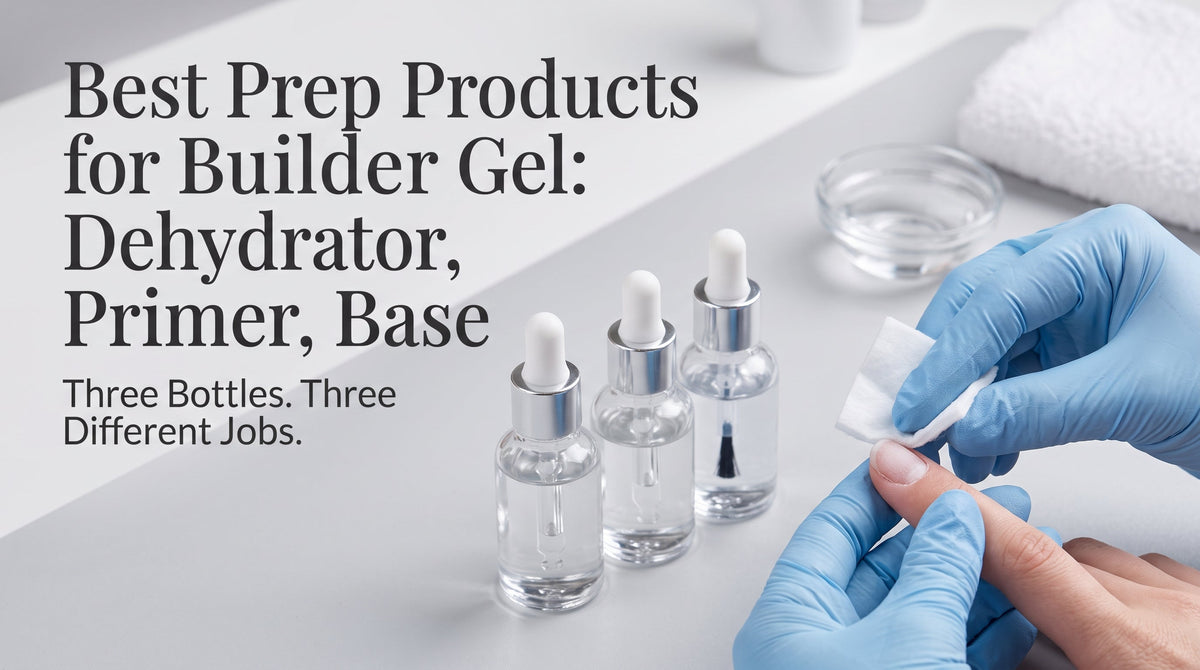
The best prep products for builder gel are the same three bottles that work for SNS dip powder: a cleanser or acetone wipe (surface oil), a dehydrator (pulls moisture from inside the plate), and a bond or primer (chemical grip for the first layer).
Treat them as three separate jobs, not three progressively better versions of the same product, and apply in that order every time. Acid primer is only for clients whose nails lift from oily beds; it is not a required bottle for most home users on either system.

Many SNS customers run both systems at home. SNS dip powder for a strong week-long color set, and builder gel for length, overlays, or French tips. Both systems lift from the same two causes: skin oil left on the plate, and water trapped inside the plate. The LAVIS Nail Prep PH Bond - 0.5 oz and LAVIS Gel Polish Protein Bond & Primer - 0.5 oz exist to fix those two causes, in that order.
This guide covers the three prep products in plain language, when each is actually needed, how to apply them without burning or over-drying, and how to read confusing brand labels so you buy the right bottle the first time. The science is the same whether you finish with SNS Nutri-Plus powder or a builder gel for extensions.

Three Prep Bottles, Three Different Jobs for Builder Gel and Dip
The single most common prep mistake is treating these three bottles as three progressively-better versions of the same product. They are not. They do three different jobs, and skipping any one of them produces a different kind of lifting a week later.
What each builder gel prep products bottle actually does
An acetone wipe or cleanser removes surface oil and residue. It evaporates in seconds and leaves nothing behind on the plate.
A dehydrator does something different. It pulls moisture from inside the natural plate through evaporation, and it leaves the plate with a chalky matte white cue when it is working.
A bond or primer is the chemical bridge. It creates the actual grip between the dry plate and the first layer of product, whether that first layer is SNS base coat for dip or a self-leveling builder gel.
The depth split matters. Acetone cleans the surface. Dehydrator pulls moisture from inside. Bond anchors the chemistry. If you skip the acetone wipe you have oil trapped under everything. If you skip the dehydrator you have water trapped under everything. If you skip the bond you have no chemical grip at all. Each one solves a problem the other two cannot.

How to Read the Label on Builder Gel Prep Products Across Brands
Manufacturers do not agree on names for the same step. The same functional product shows up on different shelves as primer, bond, bonder, protein bond, pH primer, non-acid primer, acid primer, or ultra bond. Some brands even use primer and bond interchangeably on the same bottle.
The consequence is real. You grab the bottle labeled dehydrator and apply it. Then you reach for the bottle labeled bonder and apply that. In many brand lines the second bottle is a non-acid primer, which chemically does the job of a bond. Your prep works. In other brand lines the second bottle is actually a second dehydrator or a pH balancer, which does not create chemical grip. Your prep fails three days later at the cuticle line.
Read builder gel prep products by behavior, not by name
If a product is a thin fast-drying liquid that is applied before any coat and does not create a visible film, it is doing the dehydrator job.
If a product is slightly thicker, has a slight tack when touched, or dries to a thin invisible layer that the first product layer sticks to, it is doing the bond job.
If a product has methacrylic acid listed on the ingredients panel and comes with a safety warning, it is an acid primer and should be reserved for clients whose nails lift from oily nail beds despite proper bond application.
| Bottle on your shelf says | Chemical job it does | Where it goes in prep order |
|---|---|---|
| Cleanser, surface cleaner, nail cleanse | Removes surface oil and residue | First, right after shaping and buffing |
| Dehydrator, prep, pH bond, nail prep | Pulls moisture from inside the plate | Second, after cleanser dries |
| Bond, bonder, non-acid primer, protein bond | Chemical grip for first product layer | Third, after dehydrator fully air-dries |
| Acid primer, methacrylic primer, ultra bond | Extra adhesion for oily nail beds only | Replace step 3 for problem clients only |
| Base coat (SNS Nutri-Plus) or self-leveling gel | First product layer, color system begins | Fourth, after bond flashes off |
Builder Gel Prep: Four Rules for Using a Dehydrator Correctly
The dehydrator step is quick to describe and easy to get wrong. It is a solvent-based liquid, usually acetone or isopropyl alcohol with a small amount of other agents, that pulls moisture from the natural plate through evaporation. The four rules below apply whether you are prepping for SNS dip or for builder gel.
Builder gel prep rule 1: Thin, even coat
Wipe on a thin, even layer across the whole plate using a lint-free wipe or a dedicated dehydrator brush. Pooling at the cuticle traps dehydrator against skin and causes stinging within 30 seconds. The goal is a thin even film that evaporates in under a minute, not a wet pool.
Builder gel prep rule 2: Air-dry 30 to 60 seconds, no assistance
Let it air-dry for 30 to 60 seconds without blowing on it, fanning it, or waving the hand. Blowing adds moisture from your breath back onto the plate, which is exactly what the dehydrator was trying to remove. Fanning cools the plate too fast and leaves micro-condensation. Let evaporation do its job.
Builder gel prep rule 3: Watch for the chalky white cue
The plate should turn a chalky matte white as the dehydrator works. That color change is the visual signal that moisture has evaporated and the surface is ready for the next layer. If the plate still looks pink and glossy, the dehydrator either did not have enough contact time or it was applied too thinly. Apply a second thin coat and wait again.
Builder gel prep rule 4: Apply bond immediately after the dehydrator dries
The plate begins re-absorbing ambient moisture within minutes. If you dehydrate ten nails and then stop to answer a message, by the time you come back the first few nails have already re-humidified. Dehydrate one hand, bond that hand, then move to the second hand. Keep the chain short.

Acid Primer Prep Products for Builder Gel: When to Use It, When to Skip
Acid primer contains methacrylic acid and etches the surface of the natural plate to create micro-pits that product layers mechanically grip. It is the strongest adhesion tool on the shelf, and for most home users on either SNS dip or builder gel, it is not needed and should be avoided.
When acid primer in builder gel prep products is actually warranted
Reserve acid primer for a specific problem: a person whose nails lift from the cuticle line every single set, within three to five days, on both SNS and builder gel systems, despite proper cleanser-dehydrator-bond prep. That lifting pattern usually points to naturally oily nail beds where regular bond chemistry cannot create enough grip. Acid primer solves that specific problem by giving the first layer mechanical anchor points, not just chemical ones.
When to avoid acid primer for builder gel prep products
If your sets hold for one to two weeks on the current cleanser-dehydrator-bond workflow, do not add acid primer. It etches the natural plate every time you use it. Over months of repeated use on nails that did not need it, the plate thins and sensitivity rises. The downside is permanent plate damage; the upside is zero, because the regular bond was already working.
| Your situation | Acid primer verdict |
|---|---|
| Sets hold 10+ days on cleanser-dehydrator-bond prep | Do not add acid primer. You do not need it. |
| Sets lift at the cuticle within 3-5 days on both SNS and builder gel | Try acid primer at the cuticle zone only, one coat, for this specific problem. |
| Oily nail beds and visible plate shine even after dehydrator | Acid primer is reasonable; use the smallest amount that solves the lifting. |
| You are new to home nails and your first few sets lifted | Fix the cleanser-dehydrator-bond workflow first. Do not jump to acid primer. |
| Thin, damaged, or peeling natural nails | Avoid acid primer. Use a protein-formula bond instead for both adhesion and plate reinforcement. |
The Seven-Step Prep Order for Both Builder Gel and SNS Dip Systems
The prep order below works identically for a builder gel extension set and for an SNS dip powder color set. The only step that differs is step 7, which is the first product layer specific to your chosen system. Everything before that is the same chemistry.
Prep step 1 for builder gel: Push back and clean the cuticle
Soak-free cuticle work only. Push the cuticle back with a wood or metal pusher, lift any dead tissue off the plate with a cuticle remover, and scrape the shine of dead skin off the plate near the cuticle line. If product sits on dead cuticle tissue, it lifts with that tissue three days later. This step takes the longest and is the most skipped.
Prep step 2 for builder gel: Shape and length the free edge
File the free edge to the length and shape you want before any product goes on. Filing after product is applied disrupts prep chemistry and can tear the first layer away from the plate at the free edge. Do shape first, product second.
Prep step 3 for builder gel: Buff the plate to remove shine
A 180-240 grit buffer, two to three passes across each plate, is enough to break the natural shine without thinning the plate. The goal is a matte surface the dehydrator and bond can grip, not a sanded-down plate. If you can see a dust mark on your nail after buffing, you are buffing too hard.
Prep step 4 for builder gel: Dust off and acetone wipe
Brush the dust off and wipe each plate with an acetone-saturated lint-free pad. This removes buffer dust, surface oil from your hands, and any residue from the cuticle work. Do each finger individually; a single swipe across all ten moves oil from one finger to another instead of removing it.
Prep step 5 for builder gel: Dehydrator
Apply dehydrator following the four rules above. One thin even coat, air-dry 30 to 60 seconds, watch for the chalky white cue, then move to step 6 within the 60-second window.
Prep step 6 for builder gel: Bond or non-acid primer
Apply a thin coat of bond or non-acid primer across the whole plate, including the free edge. The free edge is where most lifting starts, so do not skip wrapping product around it. Let the bond flash off until the surface is just tacky to a dry fingertip, usually 10 to 20 seconds.
Prep step 7 for builder gel: First product layer
For SNS dip powder: apply a thin coat of SNS base coat, dip the finger into Nutri-Plus powder at an angle, tap off excess, and move to the next finger before the base coat sets.
For builder gel: apply a self-leveling builder gel bead to the center of the plate, let it level for 5 to 10 seconds, shape with a brush, and cure. Both systems follow the same prep up to this point; only the color or structure layer differs.

Diagnose Builder Gel Prep Products Failure by Where Lifting Starts
When a set lifts, where it lifts tells you which prep step failed. The pattern is the same whether you are running SNS dip or a builder gel extension, because the same prep failures produce the same lifting patterns on both systems.
| Where the set lifts | Prep step that likely failed | Fix for next set |
|---|---|---|
| Cuticle line, within 3-5 days | Cleanser or acetone wipe skipped, or dead cuticle not pushed back | Push cuticle back fully in step 1, acetone-wipe each finger individually in step 4 |
| Free edge, within a week | Free edge not capped during product application | Wrap base coat or builder gel around the free edge at every layer, not just the first |
| Whole set, lifting across multiple fingers | Dehydrator skipped or not fully dried before bond | Verify the chalky white cue in step 5; wait the full 30-60 seconds before step 6 |
| Between two specific layers, delamination | Bond mismatched with first product layer, or bond skipped | Confirm bond chemistry is compatible with your base coat; apply bond in step 6 to every plate |
| Air bubbles or pitting inside the cured gel | Product placed on dehydrator that had not fully dried | Wait the full 60 seconds in step 5; no blowing, no fanning |
| One hand lifts, the other holds fine | Oil contamination on the hand that lifted | Acetone-wipe both hands immediately before bond, even if only one hand was handled recently |

What to Stock at Home: Three Prep Bottles for Builder Gel and Dip Users
Most home users on either SNS dip or builder gel need at least three bottles total: cleanser, dehydrator, and bond. That is the full prep kit for the vast majority of sets. Add acid primer only if you have the specific oily-nail-bed problem described above, and add a protein-formula bond only if your natural nails are thin, peeling, or recovering from damage.
| Your situation | What to stock |
|---|---|
| General home use, SNS dip and occasional builder gel extension | Cleanser, dehydrator, bond. Three bottles, none skipped. |
| Home use, nails hold 10+ days, want to simplify | Cleanser, dehydrator, and a documented two-in-one bond that replaces the separate bottle. Verify both jobs are listed on the label. |
| Weak, thin, or damaged natural nails | Cleanser, dehydrator, and a protein-formula or keratin bond for adhesion plus light plate reinforcement. |
| Very oily nail beds, have already tried regular bond and still lift | Cleanser, dehydrator, bond, plus acid primer for the cuticle zone only on your own nails. Not required for anyone else. |
| You use a color system that has its own pH balancing step built in | Follow that system's rules for the color line but keep a full bond or non-acid primer step for the plate itself. The two steps do not substitute. |
One constraint on all prep work. Never over-file or over-buff the natural plate. Thinning the plate produces sensitivity, long-term adhesion problems, and visible damage that takes months to grow out. The goal of prep is a clean, dry, matte plate at the surface the dehydrator and bond can grip, not a sanded-down plate.

When to Rotate or Replace Builder Gel Prep Products at Home
Prep products do not last forever. Dehydrators and bonds use volatile solvents that evaporate every time you open the bottle, which slowly concentrates the remaining liquid and changes its working time. If a dehydrator used to dry in 45 seconds and now takes 90, the bottle has thickened and lost its working concentration.
- Dehydrator: replace at six to nine months after opening, or sooner if the drying time doubles.
- Bond and non-acid primer: replace at six to nine months, or when the brush drag feels sticky or dragging.
- Acid primer: replace at six months. The acid loses potency with repeated air exposure.
- Cleanser: cleansers are mostly acetone and isopropyl alcohol; they last 12+ months if the cap seals tightly.
Store all four upright, away from sunlight, with caps fully tightened. Keeping them in a bathroom cabinet above the mirror where the shower steam reaches them is the fastest way to kill shelf life.
Frequently Asked Questions About Builder Gel and Dip Prep Products
Can I use the same prep products for SNS dip and builder gel?
Yes. Cleanser, dehydrator, and bond work identically for both systems because the natural nail plate chemistry is the same. The only part that differs is the first product layer: SNS base coat for dip or self-leveling builder gel for extensions. Steps 1 through 6 in the prep order above are shared.
Do I really need all three builder gel prep products, or can I skip the dehydrator?
Do not skip the dehydrator. Cleanser cleans the surface oil; dehydrator pulls moisture from inside the plate. These are two different jobs that both need to happen before bond. Skipping dehydrator is the single most common cause of lifting across the whole set within four to five days.
Can I use the same bond across builder gel and dip prep products?
A good non-acid primer or bond works for both SNS dip and most builder gel systems. Check the ingredient list for methacrylate chemistry and confirm the brand does not list a specific color system you must pair it with. Some manufacturer bond and base coat combinations are tuned to each other and work slightly better paired, but a universal non-acid primer is a reasonable default.
My nails lift at the cuticle. Is my builder gel prep products dehydrator broken?
Cuticle-line lifting within 3 to 5 days is almost always a step 1 or step 4 problem, not a dehydrator problem. Dead cuticle tissue was not pushed back fully in step 1, or oil from your hands was not wiped off the plate individually in step 4. Fix those two steps before replacing the dehydrator.
When should I use acid primer in builder gel prep products?
Only when a person has naturally oily nail beds and sets consistently lift from the cuticle line within 3 to 5 days despite correct cleanser-dehydrator-bond prep. If your sets hold for a week or more on regular bond, do not add acid primer. It etches the plate every time and causes thinning over months of use that was not needed in the first place.
About the Authors of This Builder Gel Prep Products Guide
Anna Nguyen, Builder Gel Prep Products Author
Anna is a licensed nail technician based in San Jose, California with 5+ years of experience teaching home users how to run SNS dip powder and builder gel systems safely. She has coached 150+ SNS DIY customers through at-home sets, including customers who use both systems in rotation. Her coaching focuses on prep chemistry, lift diagnosis, and plate preservation.
Michelle Tran, Builder Gel Prep Products Reviewer
Michelle has operated her SNS-focused salon in Houston, Texas since 2019 and currently serves 200+ clients a month. Her team runs cleanser-dehydrator-bond prep on every set, dip and extension alike, and tracks lifting patterns by client to tune the prep workflow for each case. She reviewed this article for technical accuracy on October 1, 2026.
Sources for Builder Gel Prep Products and Related SNS Guides
External Sources for Builder Gel Prep Products
- European Chemicals Agency (ECHA): methacrylic acid safety profile and classification. echa.europa.eu
- NAILS Magazine: technical references on dehydrator, bond, and primer chemistry for nail systems. nailsmag.com
Related SNS Foundation Series Guides for Builder Gel Prep Products Users
- How to Apply SNS Dip Powder at Home: step-by-step pillar guide
- Nail Anatomy for SNS Dip Users: plate science foundation
- SNS Dip Powder Thickness Guide: structure and 2mm build limit
- Nail Tips, Gel X and Dual Forms: SNS extension companion
- SNS DIY Tool Kit Guide: files, brushes, e-file safety
- How to Remove Dip Powder at Home: safe removal workflow
- SNS Top Coat Cure Time: equipment diagnostic
- LED Lamp Wattage Guide: lamp power for dip and gel
- Nail Lamp Heat Spike: managing cure heat safely
- SNS Overlay Style Guide: visual choices for color sets
- What Is SNS Dip Powder: master pillar definition


