

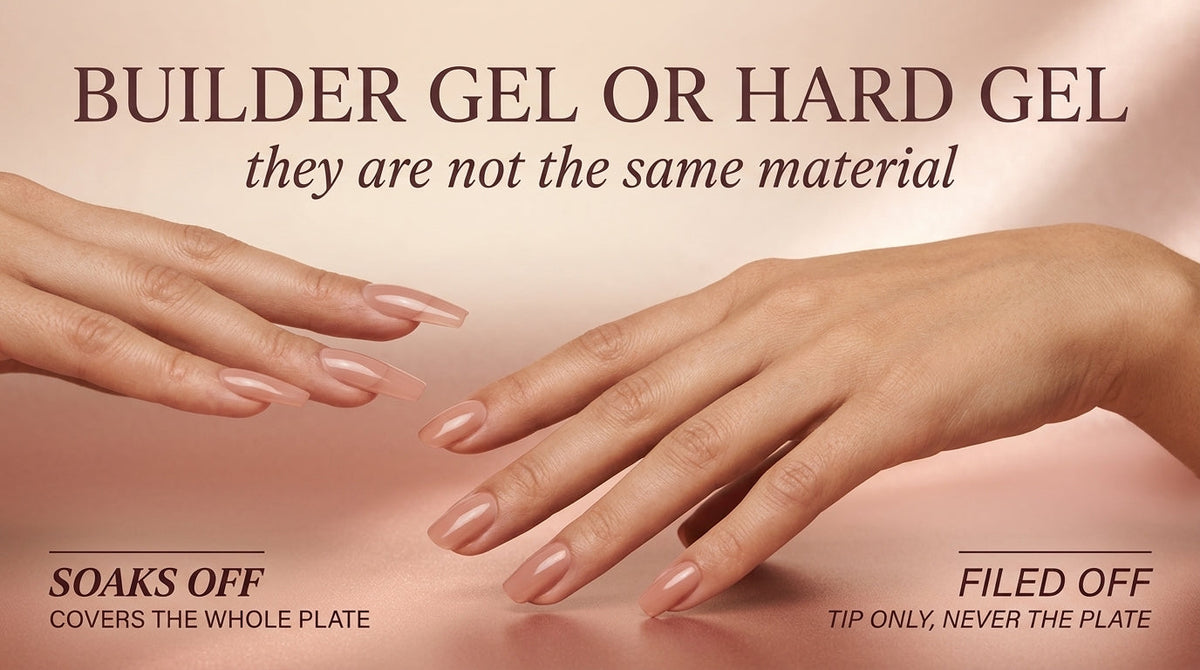
No. Builder gel and hard gel are not the same product, and the difference that matters most is how they come off. Builder gel mostly soaks off in acetone; hard gel does not dissolve in acetone at all and has to be filed off. That single fact commits you to a specific removal workflow for the entire life of the set. This guide walks you through the three differences that matter, the three viscosity levels every brand builds within, the five product formats on the market, four confusing label names to decode, and the one pick-the-format table that tells you which type suits which service.
Fast Facts
- The biggest difference between builder gel and hard gel is not hardness. It is a REMOVAL METHOD. Builder gel soaks off; hard gel files off only.
- Hard gel is NOT an upgraded version of builder gel. It is a different material for a different zone of the finished nail: builder gel handles the nail plate, hard gel handles the extension tip only.
- Every builder gel bottle belongs to one of three viscosity levels: classic (thinnest, self-levels fast), builder (semi-soft, the default), or control (thickest, for sculpting).
- There are five product formats: brush-in-a-bottle (BIAB), jar, non-sticky jar for 3D work, poly gel, and rubber base. Non-sticky and rubber base are NOT builder gel even though they share the shelf.
- Poly gel's slip solution lubricates the brush. It does NOT thin the product. Using too much slip solution causes the gel to lose structure and run.
- "Soft gel" means two entirely different things. Read the label carefully before ordering, because "soft gel builder in a bottle" and "soft gel tips" are not the same product category.
- Rubber base is not builder gel. Two numbers say it all: rubber base 0.3 to 0.5 mm, builder gel 1 to 2 mm. Four-fold thickness difference means two different roles in the same set.

Is Builder Gel the Same as Hard Gel? Three Differences That Matter
About 2,400 people per month combine to ask a version of this question online (per internal keyword volume mapping as of October 2026). The answer is no. Three specific differences separate the two products, and one of them commits you to a workflow for the entire life of the set.
| The difference | Builder gel | Hard gel |
|---|---|---|
| 1. Removal (the difference that matters most) | Most bottle-form builder gel SOAKS OFF in acetone. Faster removal, gentler on the plate over multiple cycles | DOES NOT DISSOLVE in acetone. Must be FILED OFF completely, at every removal, forever |
| 2. Flexibility | Moderately flexible. Moves with the natural nail as the finger flexes | RIGID. Holds shape more firmly, which is why it can carry long extension length |
| 3. Where it belongs on the nail | Whole nail plate. Structural layer covering the natural nail | EXTENSION TIP ONLY. Not on the nail plate, because its cure heat can lift the natural nail from the tissue underneath |
The removal difference is the one to prioritize. Everything else can be adjusted between appointments; removal method commits you to a specific workflow for the entire life of the set. Ask which one you are getting at the CHOOSING appointment, not at the removal appointment weeks later when the answer is no longer useful.
Hard gel is not a stronger version of builder gel. It is a different material for a different zone of the same finished nail. Builder gel handles the nail plate. Hard gel handles the extension tip only. On sets that use both, each does the job the other was not designed to do.
For the broader comparison across all six nail-extension systems including acrylic, poly gel, Gel X, and tip overlay, see Builder Gel vs Gel X vs Hard Gel vs Acrylic: Which One Do You Actually Need? (draft completed).
Why Hard Gel Only Belongs at the Extension Tip

The technical documentation is direct on this point: hard gel is not recommended for use on the nail plate itself because its cure reaction releases significant heat, and that heat sits directly on the natural nail bed if the hard gel is placed there. Enough thermal buildup at the plate level can lift the natural nail from the tissue underneath. This mechanism is consistent with Doug Schoon Nail Structure and Product Chemistry on hard gel exothermic cure heat and the mechanical consequence of placing a high-heat-release coating directly on the natural nail bed.
So hard gel goes at the extension tip only, where the coating is not sitting on living tissue. On a finished nail that uses both materials, builder gel or another flexible system handles the portion sitting on the natural plate, and hard gel provides the rigid load-carrying capacity at the projection past the fingertip.
What this means when you ask for "a stronger set." If a technician offers hard gel as the answer to "I want stronger nails," ask a follow-up: do you mean stronger on the plate, or stronger at the tip? The correct answer for "stronger on the plate" is still builder gel with better apex placement, NOT hard gel. Hard gel on the plate is not the fix for a wear complaint; it is a different problem introduced.
Three Viscosities: Classic, Builder, Control

Every builder gel bottle on the market belongs to one of three viscosity levels. Reading these three levels off any label, instead of trying to remember which brand does what, is the portable skill that saves the most bad purchases.
| Level | What it does | Best for | Common mistake |
|---|---|---|---|
| Classic | Thinnest. Self-levels fast | Fast overlay, thin coverage | Cannot hold an apex. Drops flow toward the cuticle before cure |
| Builder | Semi-soft. Does not run. Holds where placed | The DEFAULT for most builder gel work: overlay, structured manicure, short extensions | This is the right level for most jobs. Wrong-level complaints usually mean the buyer picked up a different level and thought it was builder |
| Control | Thickest. Stays exactly where placed | Sculpting, thick application, controlled apex work | Heavy brush pressure required to spread. Users complain "this bottle is too thick" when they should have picked builder level |
A surprising note for beginners
Thicker viscosities are typically classified as EASIER to learn than thinner ones. The reason is mechanical: a thicker gel holds its shape on its own, so you do not need to invert your hand to keep the apex from running toward the cuticle before the lamp fires. Trade-off: a thicker bottle needs more brush pressure to spread. But the automatic form-holding is a real ease-of-entry advantage.
The Five Formats on the Market
Products at this shelf come in five broad formats. Picking the wrong format means no bottle will fit your work, no matter how good the bottle is on its own. This table draws directly from the search-volume landscape data and lists the brands present in each format so you can identify what you are looking at when a bottle shows up in your feed.
| Format | What it is | What it does well | Brands present in search data | Key limitation |
|---|---|---|---|---|
| Brush-in-a-bottle (BIAB) | Medium-to-thick viscosity, applies like nail polish | Overlay, structured manicure, short extensions 2 to 3 mm | LAVIS, Luminary, IBD, Nail Thoughts, The GelBottle, ORLY, CND, Gelish, OPI | Most convenient. CANNOT do long extensions |
| Jar | Thicker consistency, applied with a separate brush | Sculpting, thick layers, controlled gel placement | LAVIS, IBD, Kokoist, Akzentz, Light Elegance, Glitterbels | Needs a separate brush. Removal takes longer than bottle-form |
| Non-sticky jar | Thick and firm, does not stick to gloves, no slip solution needed | 3D flowers, raised charms, sculpted decoration | LAVIS | NOT used for whole-nail overlay |
| Poly gel / Acrygel | Hybrid powder-plus-gel, thick, does not self-level | Long extensions, alternative to acrylic for odor-sensitive clients | Kiara Sky, Beetles, Modelones, Born Pretty, Saviland | REQUIRES slip solution and often a dual form |
| Rubber base | Flexible base layer, elastic, 0.3 to 0.5 mm thick. NOT a builder gel | Cushion layer for weak natural nails | IBD, Kiara Sky, The GelBottle, Madam Glam, Valentino Beauty Pure | Fails on long extensions or under a rigid finishing layer |
The empty cell in the non-sticky row is deliberate. Fewer than three brands appear in the search-landscape data for that category, so listing one or two names would suggest a landscape that does not yet exist. Better to show the empty cell honestly than to fill it with an incomplete list. The category exists at the SKU level even where the search cell is empty: LAVIS Builder Gel Jar Non Sticky is one such SKU carried on SNS Nails, a jar-form option that cures without leaving an inhibition layer above it. Shelf availability and search-landscape density are two separate signals.
Notice the same brand appears across multiple format rows. LAVIS carries BIAB (LAVIS Builder Gel In The Bottle B1 and B2), jar (LAVIS Builder Gel In The Jar) and poly extension (SNS Pro Sculpt Poly Gel) formats across the same product family. IBD appears in BIAB, jar, and rubber base. Kiara Sky in poly gel and rubber base. The GelBottle in BIAB and rubber base. Format decides the workflow. The brand decision within a chosen format is a much smaller decision than the format decision that comes first.
Polygel and Slip Solution: Where the Most Gel Gets Wasted
Poly gel sits between acrylic and gel: it has the thick, hold-its-shape consistency of acrylic, but it does not cure until the lamp fires, so there is no acrylic-style time pressure to shape it within a set window. That combination is why many new technicians favor it. And that combination is also where the most gel gets wasted, because the same forgiving working window makes the slip solution mistake easy.
It guides the brush, not the product. Dip the brush damp, stroke short and controlled, reload only when needed. Use too much and the poly gel loses structure. It runs, spreads into the cuticle, and refuses to hold shape.
The technical documentation is explicit: slip solution is a brush lubricant, not a thinner, not a solvent, and not a substitute for correct brush pressure. This mechanism is consistent with cosmetic chemistry documentation on surfactant brush lubricants that reduce stiction without thinning the product itself. Overusing it produces a poly gel bead that will not hold its shape. The mass loses structural integrity, spreads uncontrollably toward the cuticle area, and refuses to form a defined apex. Users then fight the product for the whole appointment and blame the poly gel bottle when the correction was in the brush technique.
The four-step technique that works. One: dip the brush DAMP, not soaked. Two: make short controlled strokes rather than long dragging ones. Three: let the poly gel hold its shape between strokes rather than working it constantly. Four: reload slip solution on the brush only when the brush genuinely runs dry, not preemptively between every stroke.

Structure Gel, Liquid Gel, Solid Gel, Soft Gel: Labels, Not Categories
Four names appear repeatedly in product listings and menu boards, and none of them describe a new product category. All four are either alternative names for something you already know, or brand-specific marketing names for a viscosity level within the existing three-level range.
| What the label says | What it actually is | How to handle it |
|---|---|---|
| Structure gel | Alternative name for BUILDER GEL, emphasizing the structural function | Read the viscosity description on the label. Ignore the marketing name at the top |
| Liquid gel | Usually builder gel at the CLASSIC (thinnest) viscosity level | Thinner viscosity spreads fast but does not hold an apex well |
| Solid gel | Usually builder gel at the CONTROL (thickest) viscosity level, or a jar-format product | Requires brush pressure to spread. Best for sculpting |
| Soft gel | TWO ENTIRELY DIFFERENT THINGS depending on context. See warning box below | Read the full product description before ordering |
In some product listings "soft gel" refers to soak-off gel generally (the whole category of gel products that dissolve in acetone). In other listings "soft gel tips" refers to pre-formed full-cover nail tips (often called Gel X) that get glued onto the natural nail. Two entirely different products carrying the same two-word label.
Order the wrong one and you will get either liquid product when you wanted shells, or shells when you wanted liquid product. Always read the full item description, not just the label heading.
For the specific Gel X versus builder gel decision including which natural nail shapes the pre-formed shells fit and which ones they do not, see Gel X vs Builder Gel: Which One Fits Your Client's Nails? (draft completed). For the companion workflow on using soft gel tips with builder gel in a layered stack, see Can You Do Builder Gel with Tips? SNS DIY Compatibility Rules.
A note on prep-step naming chaos. This industry does not standardize its terminology. The single preparation step of preparing the nail plate has been variously labeled primer, bond, bonder, protein bond, pH primer, and base bond depending on the brand. Some brands even label their dehydrator product "bonder." The rule of thumb: read the description of what the product does, not what it is called.
Is Rubber Base the Same as Builder Gel? Two Numbers Say It All

Rubber base and builder gel share shelf space and both feel flexible in the bottle, which produces the common assumption that they are the same category. They are not. Two numbers say it all.
The thickness difference. Rubber base is designed to apply at 0.3 to 0.5 mm. Builder gel is designed to apply at 1 to 2 mm with an apex. That is roughly a four-fold difference in structural thickness. Two products with that much difference in designed thickness are not versions of the same category. They are different roles in the same finished set.
Rubber base CUSHIONS. It absorbs movement from the natural nail underneath it, which protects a weak plate from stress cracking at the base of the projection. It does not build any structure. It has no apex. Builder gel SUPPORTS. It carries load along the length of the nail and distributes stress across the whole coating. It has an apex specifically for that job.
The two products are often used TOGETHER in the same finished set rather than as substitutes for one another. Rubber base sits directly on the natural plate as a cushioning foundation. Builder gel sits above the rubber base as the structural layer that carries load. Neither product does both jobs; each does one job well.
For the full three-cases-where-rubber-base-fails deep dive and the specific client cases where the two products should be used together versus separately, see Rubber Base vs Builder Gel: When to Use Which (draft completed).
Pick the Format for the Job
This table condenses the whole guide into one decision reference. Match the service you want to the correct format and viscosity in one pass.
| What you want | Format | Viscosity level |
|---|---|---|
| Natural-looking overlay on the natural nail | Brush-in-a-bottle | Builder |
| Structured manicure with a defined apex | Brush-in-a-bottle or jar | Builder or control |
| Short extension of about 2 to 3 mm | Brush-in-a-bottle or jar | Builder |
| Sculpting, thick layers, custom shape | Jar | Control |
| 3D flowers, raised charms, decoration | Non-sticky jar | Not applicable |
| Long extension, alternative to acrylic for odor-sensitive clients | Poly gel | Not applicable |
| Cushion layer for very weak natural nails | Rubber base | Not applicable |
| Long form-built extension with maximum rigidity | NOT builder gel. Hard gel at extension tip, or acrylic | Not applicable |
The last row is the ceiling to remember. Builder gel handles overlay and short extensions of about 2 to 3 mm. Anything longer requires a different system, because the coating is not designed to hold the added mass beyond that range. This is the CEO-approved guidance from the product FAQ. Across the builder gel lineup carried on SNS Nails, that ceiling reads the same way: SNS Builder Gel In The Bottle (24 shades, HEMA-Free and TPO-Free, 0.5oz), LAVIS Builder Gel In The Bottle B1 and B2 (72-color HEMA-Free TPO-Free bottle set), LAVIS Builder Gel In The Jar (18-shade 30ml denser jar format), and LAVIS Builder Gel Jar Non Sticky (per-shade 15g and 30g, cures without an inhibition layer) all sit inside the 2 to 3 mm range for their category. LAVIS Poly Extension Gel handles the polygel-format decision at longer projections.
Related Articles
Live on SNS Nails right now:
How this article was developed
Sources. SNS internal technical reference on gel category disambiguation plus three viscosity levels (classic, builder, control) and five product formats (BIAB, jar, non-sticky jar, poly gel, rubber base) plus hard gel cure heat mechanism; CEO-reviewed product FAQ Q3 for the 2-to-3mm builder gel extension ceiling; Doug Schoon Nail Structure and Product Chemistry on hard gel exothermic cure heat and nail-bed thermal buildup; cosmetic chemistry documentation on surfactant mechanism (slip solution as brush lubricant, not thinner); SNS pain-library records on buyer-side confusion patterns (hard gel offered as upgrade, slip solution overuse, "soft gel" ambiguity); internal keyword volume mapping as of October 2026 for the "builder gel types" cluster (2,400 monthly for hard gel pair plus 12,190 cluster total).
Frequently Asked Questions
Is builder gel the same as hard gel?
No. Three differences: removal method (builder soaks off, hard files off only), flexibility (builder is moderately flexible, hard is rigid), and placement (builder covers the whole plate, hard belongs at the extension tip only because of its cure heat).
Why cannot hard gel go directly on the natural nail plate?
Its cure reaction releases significant heat. Placed on the natural nail plate, that heat can lift the natural nail from the tissue underneath. So hard gel goes at the extension tip only, where cured heat has nowhere to damage.
What are the three viscosity levels of builder gel?
Classic (thinnest, self-levels fast but cannot hold an apex), builder (semi-soft, the default for most work), and control (thickest, for sculpting and thick apex work). Reading these off the label works across every brand.
What is slip solution for, and what is it NOT for?
Slip solution is a brush LUBRICANT for poly gel work. It is not a thinner, not a solvent, and not a substitute for correct brush pressure. Too much slip solution makes poly gel lose structure and run toward the cuticle.
What does "soft gel" mean?
Two different things. In some listings it means soak-off gel generally. In "soft gel tips" it means pre-formed full-cover nail shells (Gel X). Read the full product description, not just the label heading, to avoid ordering the wrong item.
Is rubber base the same as builder gel?
No. Rubber base is 0.3 to 0.5 mm thick and cushions the plate. Builder gel is 1 to 2 mm thick with an apex and carries load. Four-fold thickness difference, two different roles. Often used together in the same set, not as substitutes.


