Quick Answer
If you are asking why does my builder gel peel off in one whole piece, the bond never actually formed in the first place. That is different from lifting, which is a bond that formed and slowly failed from one edge. Builder gel peels off because of a prep-chain problem: usually an oily plate that never dehydrated properly, an acetone wipe mistaken for a dehydrator, or leftover cuticle oil on the plate when the first layer went down. Switching bottles rarely fixes it. Fixing the final two prep steps almost always does.
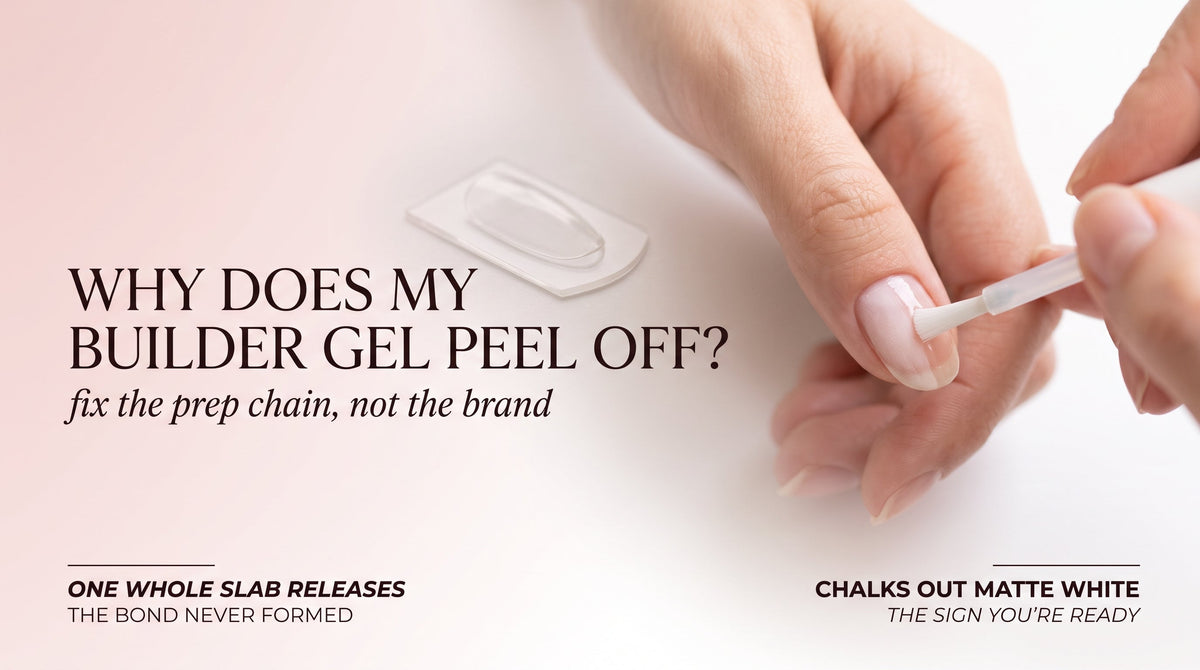
If a whole slab of builder gel came off your nail holding the exact shape of the nail underneath, you are not looking at the same problem as someone whose gel chipped from one corner. You are looking at a bond that never formed. The fix is in the prep chain, not in the bottle you used. This guide walks through the one-photo test that tells you which failure you actually had, the two prep steps DIY users mix up most often, why switching brands does not solve this, and the fix checklist for your next home set.
Peeling vs Lifting: Why Your Builder Gel Peels Off in One Piece
These two failures look similar in the moment and need completely different fixes. Grouping them together is why people rebuild one step that was not the problem and watch the same thing happen again next time.
Lifting starts at a single edge: the cuticle line, a sidewall, or the free edge. The bond at that edge failed, and the gap travels inward. The middle of the nail is still bonded. When the released piece is pulled, it comes off torn and uneven.
Peeling has no starting edge, because the entire contact surface never bonded at all. A few flexes of the finger, one knock against a door, and the whole slab tents up as one continuous piece, holding the exact shape of your nail underneath. The teaching moment: lifting is a bond that formed and slowly failed from one weak spot. Peeling is a bond that never formed at all. The surface was compromised before the first bead of gel touched it.
That means fixing lifting is about correcting one specific step. Fixing peeling is about running the whole final stretch of the prep chain.

Look at the Nail Plate After Your Builder Gel Peels Off
The cheapest test in the whole diagnostic, and the one most often skipped at home: keep the released piece of gel, and look closely at the nail plate directly under it. Two visible states show up, and the underlying surface tells the story that nothing else will.
- If the plate underneath is smooth and flat, the bond never formed. The gel tented up without taking any of the plate with it. This is a prep problem: oil on the surface, interior moisture not dehydrated, or an acetone wipe used in place of a dehydrator. The fix is in your prep sequence.
- If the plate underneath is layered, rough, or chalky-white in patches, there is visual evidence of a removal or picking event in the past. Ripping or peeling gel off tears the top keratin layers of the plate. Your natural nail is only about 0.3 mm thick to start with. Strip a layer off, and the next set of gel begins on compromised keratin.
Take a photo while the plate is fresh. This settles the question that shows up in every forum thread about why does my builder gel peel off: was it the last removal, or was it this set's prep. The plate itself answers.

The Adhesion Chain: What Breaks When Builder Gel Peels Off
Builder gel adhesion is not a single step. It is a chain of conditions, where each prep step is a link. Dropping any single link makes the set vulnerable. A peeled nail is pointing at the missing link.
For peeling specifically, the answer is almost never one step. It is the final stretch of the chain, the sequence that runs from removing dead cuticle tissue, through buffing, through cleansing, through dehydrator, through bond or primer, and into the first thin layer of builder gel.
Lifting hands you a specific edge to inspect. Peeling only hands you a whole slab and a smooth plate. So the fix is not guesswork. It is running the whole final stretch of the chain carefully next time, one link at a time.
Dehydrator vs Acetone Wipe: The Mistake That Makes Builder Gel Peel Off
These two products get treated as the same thing constantly by home users. They are not. Getting this pair wrong is one of the top causes of the never-bonded plate that hands you a whole-slab peel-off two weeks later.
Acetone wipe cleans the surface. It picks up oil and dust that sit on top of the plate. It does not, and cannot, pull moisture out of the interior of your nail.
Dehydrator pulls interior moisture out. It draws water from inside the plate to the surface, where it flashes off. It does not replace the buffing step, and it does not replace the cleanser wipe. It is a bridge between physical prep and the first adhesive layer.
Correct order at home: acetone wipe first, dehydrator second. Let the dehydrator air-dry naturally for roughly 30 to 60 seconds. No blowing, no fan. The sign it is working: the plate turns chalky-white to the eye as the moisture flashes off. If it stays glossy, there is still oil or interior moisture on the surface. Repeat the dehydrator step until the plate chalks out evenly.

Oily Nail Plates: The Most Common Reason Builder Gel Peels Off at Home
Oily plates are the single most common reason builder gel peels off. Oil blocks the bond. Dehydrator alone handles most plates, but a plate that runs genuinely oily needs one extra step.
The check: after the dehydrator, look at your nail. Any spot that does not chalk out to a matte white is still holding oil. That spot is exactly where an acid-based primer does its job. Acid primer etches a microscopic texture into the plate that oil cannot block. Use it sparingly, apply only to the spots that stayed glossy, and let it air-dry before the base coat goes down.
Two things to say clearly. First, an oily plate is not a reason to switch brands. Handled correctly with a bond step matched to your plate type, oily nails hold builder gel fine. Second, asking yourself "do I have oily nails" is only half the check. Most people with oily plates do not know. The reliable check is the chalk-out test after dehydrator.

Why Switching Brands Won't Stop Your Builder Gel from Peeling Off
The natural next question when builder gel peels off is "maybe I should switch brands." The landscape says otherwise.
Whole-slab peel-off shows up across bottle and jar formats and across every major builder gel line on the market. Bottle-form systems documented with peel-off cases include Luminary, IBD, Nail Thoughts, The GelBottle, ORLY, and CND Plexigel. Jar-form systems include IBD, Kokoist, Akzentz, Light Elegance, and Glitterbels. Every major line has recorded peel-off cases.
That is because peel-off is a plate-surface failure, not a bottle-chemistry failure. A different bottle placed on the same oily, under-dehydrated plate produces the same slab release. The only difference is the receipt and the extra two weeks it takes to notice. Fix the prep chain before you spend money on a new bottle.

Removal Damage: When Builder Gel Peels Off Because of Last Time
If the plate under your peeled gel looks layered or chalky, this set's prep is not the whole story. Ripping or picking gel off at a previous removal tears the top keratin layers of the plate. The next set of gel starts on a compromised surface and cannot bond properly.
Two rules to break the cycle:
- Never rip or pick builder gel off. Always soak off in acetone. The plate is about 0.3 mm thick, and peeling pulls a layer of that off with the gel. Damage shows up on the next two or three sets before the affected layer fully grows out.
- Give the plate a recovery window. If the plate is visibly layered after removal, skip one builder gel cycle. File smooth, oil daily, and let the compromised layer grow forward before the next coating.

The Builder Gel Peel-Off Fix Checklist for Home Users
Once you know builder gel peels off because of prep, not product, here is the next-set checklist. Run every link in the final stretch of the adhesion chain.
- Dead cuticle tissue. Remove with a pusher. Any cuticle that drops back onto the plate during cleanup blocks the bond from that spot outward.
- Buff the shine. A fine-grit buffer (180/240) on the plate until the surface is uniformly matte. No shiny patches.
- Cleanser wipe. Lint-free pad with isopropyl alcohol or dedicated cleanser. Picks up the buffing dust.
- Dehydrator. Thin coat. Air-dry 30 to 60 seconds. Plate chalks out evenly.
- Chalk check. If any spot stays glossy, acid primer on those spots only.
- Thin first layer of builder gel. Dot-and-spread, not a flood. Cure fully.
- Thin second layer. Build structure in thin layers. Thick layers leave uncured product under the surface and cause surface cracks within days.

When Peeling Off Means You Need a Different Product, Not Different Builder Gel
Builder gel is formulated as a natural-nail overlay with a short extension of about 2 to 3 mm past the free edge. Longer sculpted extensions sit outside the category. A break at a longer extension is a scope issue, not a bond issue, and no prep fix in this article rescues it.
If your peel-off happens at a 5 mm or longer extension, the right move is not another builder gel bottle. It is a full-cover soft gel tip that carries the length work for you. The SNS Nails catalog carries soft-gel full-cover tips as one option when builder gel is past its structural ceiling.
Also worth an honest cross-shop: if your plate runs very oily and no amount of acid primer helps the bond hold, SNS dip powder is a structural system that uses a different adhesion mechanism entirely (resin-based, not light-cured). Some plates that fight builder gel bond fine with dip. Not a reason to abandon builder gel, but worth testing if the prep checklist above runs out of levers.
FAQ About Why Builder Gel Peels Off
Why does my builder gel peel off in one whole piece?
Because the bond never formed. The entire contact surface between the gel and your nail never bonded, usually because oil, interior moisture, or leftover cuticle residue was on the plate when the first layer went down. Fix the final two prep steps (dehydrator and chalk check) before you change bottles.
What is the difference between peeling and lifting?
Lifting starts at one edge (cuticle line, sidewall, or free edge) and travels inward; the middle is still bonded. Peeling has no starting edge because the whole surface never bonded, and the piece tents off as a continuous slab.
Is my acetone wipe the same as a dehydrator?
No. Acetone wipe cleans oil off the surface. Dehydrator pulls moisture out of the interior of the plate. Use acetone wipe first, then dehydrator. Both steps are needed.
Will switching builder gel brands stop it from peeling off?
Rarely. Peel-off is a plate-surface failure, not a bottle-chemistry failure. Every major bottle and jar line has recorded peel-off cases. Fix the prep chain before you spend on a new bottle.
How do I tell if the peel-off was from last time's removal or this set's prep?
Look at the plate directly under the peeled piece. Smooth and flat means this set's prep failed. Layered, rough, or chalky-white in patches means last time's removal tore the top keratin layers.
What if my builder gel keeps peeling off even after I fix my prep?
Three possibilities. One: the plate is still recovering from previous peel-off removal and needs a cycle off. Two: your lamp is not fully curing the first layer, so it stays soft and releases as a slab. Three: you are past the 2 to 3 mm extension range where builder gel is formulated to hold, and the real answer is a full-cover soft gel tip, not builder gel.
Related Reading on SNS
- Builder Gel on Natural Nails: Who It Suits Best (DIY Guide)
- How to Remove Builder Gel at Home Without Damaging Your Nails
- Peel-Off Base Coat with Builder Gel: Will It Work at Home?
- Builder Gel Cost at Home vs Salon: The Real Breakeven Math
- Builder Gel vs Dip Powder: An Honest SNS Cross-Shop
Sources
- NAILS Magazine. "Adhesion chemistry: prep steps, dehydrators, and acid primers on the natural plate." nailsmag.com
- American Academy of Dermatology Association. "Nail plate structure, thickness, and recovery from keratin damage." aad.org
About the author
Alan Nguyen writes the DIY nail chemistry series for SNS Nails. His focus is translating salon diagnostic techniques into honest home-use checklists for readers running their own prep between professional visits.
Reviewed by
Thao Vu, licensed nail technician, Westminster, CA. 12 years of professional overlay and extension work, with a focus on prep-chain diagnostics for oily and problem plates.
Michelle Tran, DIY nail content educator, Houston, TX. 8 years teaching home builder gel, prep sequencing, and dip technique.