

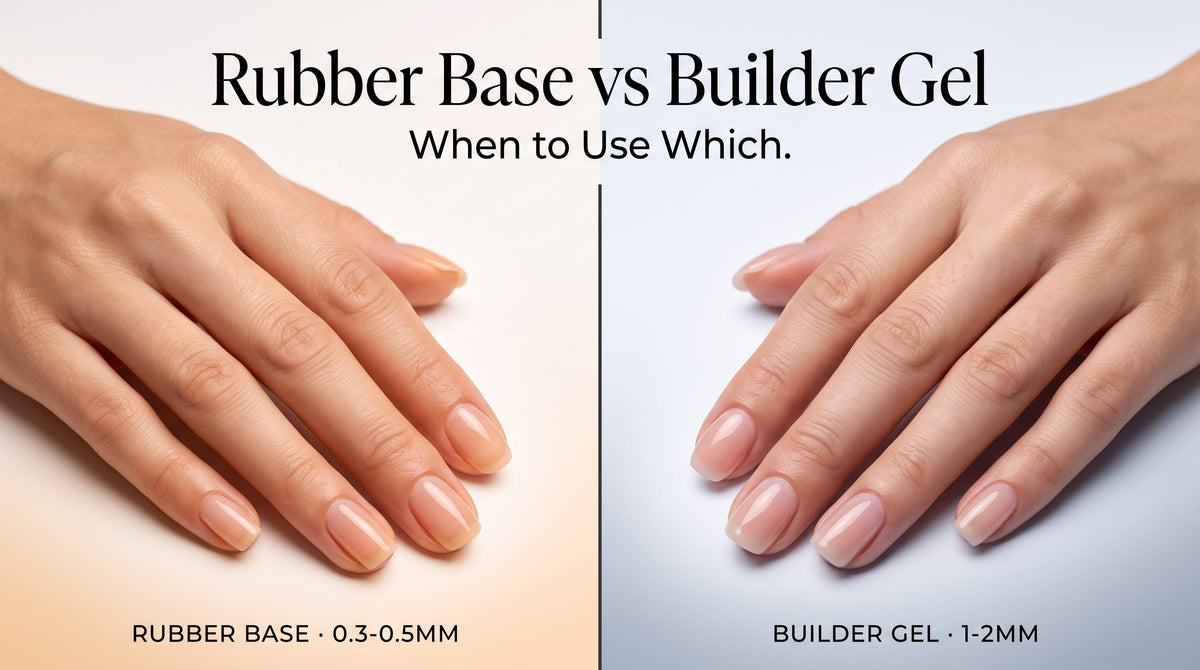
Rubber base and builder gel look similar on the shelf and get confused often in shop conversation. They should not be. Rubber base sits at roughly 0.3 to 0.5 mm as a flexible cushioning layer. Builder gel sits at 1 to 2 mm as a rigid structural layer with an apex. That is about a four-fold thickness difference, and it is not "a thicker version of the same thing". It is two different jobs mechanically and chemically.
This article covers what each layer actually does, the three cases where the rubber base fails (with a mechanism for each), when to use both together, and how to match the correct base to the client sitting in the chair. Getting the choice right prevents most of the lifting complaints that get blamed on the product when the actual issue is a layer-role mismatch.
Fast facts
- Rubber base is about 0.3 to 0.5 mm [Inferred] and CUSHIONS the natural nail. Builder gel is 1 to 2 mm and SUPPORTS load with an apex. Four-fold thickness difference, two different jobs.
- Base coat is NOT the same as bond or primer. Bond is a chemical bridge; base coat is the first cured material layer.
- Rubber base fails in three specific cases: long extensions, placement under a rigid layer, and heavy-hand clients. Case two (under a rigid layer) is the most commonly overlooked.
- Using both rubber base AND builder gel together works for weak natural nails needing structure, but only when the layer above is medium-flex builder gel, not a hard-gel finish.
- Base gel by itself does NOT add structure. Applying it thick to compensate produces uneven cure and weak spots, not durability.
Two Numbers: 0.3 to 0.5 mm and 1 to 2 mm
The two numbers answer most of the confusion between rubber base and builder gel. Rubber base applies at approximately 0.3 to 0.5 mm as a thin flexible layer. Builder gel applies at 1 to 2 mm as a structural layer with a defined apex. That is roughly a four-fold difference in thickness, and it is what separates two different roles rather than two grades of the same product. A layer four times thicker is not a stronger version of the thinner layer. It is doing a different job entirely, with a different formulation supporting that different job. The structural role is consistent with Doug Schoon Nail Structure and Product Chemistry on load mechanics across gel resin families.
The 1 to 2 mm structural role is served on SNS Nails by the SNS Builder Gel In The Bottle line (24 shades, HEMA-Free and TPO-Free, 0.5oz) and the LAVIS Builder Gel systems: LAVIS Builder Gel In The Bottle B1 and B2 (72-color HEMA-Free and TPO-Free bottle set), LAVIS Builder Gel In The Jar (18-shade 30ml denser jar format), and LAVIS Builder Gel Jar Non Sticky (per-shade 15g and 30g, cures without an inhibition layer). Rubber base from any brand sits one layer beneath these, not above them.

| Rubber base | Builder gel | |
|---|---|---|
| Applied thickness | About 0.3 to 0.5 mm | 1 to 2 mm |
| What it is | Flexible, elastic base layer | Rigid structural layer |
| Primary job | Cushion the natural plate, resist cracking on weak nails | Create apex, carry mechanical load, extend length |
| Has an apex? | No | Yes |
| Position in the stack | Below | Above the base layer |
| Removal method | Soak-off | Mostly soak-off after filing off the top two-thirds (consistent with manufacturer technical documentation on gel resin families and acetone solubility) |
Base Coat Is Not Bond or Primer
This is where shop shopping decisions cost real money. Bond, primer, and base coat are three different products, but the industry names for them overlap enough that many technicians end up buying two of the same product without realizing it. The distinction matters because each one blocks a different failure mode, and losing the distinction means losing coverage against one of them.
| Bond or primer | Base coat | |
|---|---|---|
| What it is | A CHEMICAL bridge between the natural plate and the product above | A cured GEL LAYER, the first material layer applied |
| Does it cure under a lamp? | Depends on the type. Some air-dry only | Yes, cures under the lamp |
| Layer thickness | Negligible (a thin invisible film) | A real thin gel layer with visible material |
| Can it be skipped? | NO for builder gel | No, unless the specific builder gel bottle documents that it does not require a separate base |
| Where in the sequence | Before base coat | After bond/primer, before builder |
The naming chaos runs deeper than just base vs bond. The same functional bond step appears on shelves as primer, bond, bonder, protein bond, pH primer, or base bond, and some manufacturers even label their dehydrator as "bonder". Many "we mixed brands and it lifted" complaints are actually "we accidentally applied dehydrator twice with no bond step at all". For the full three-bottle disambiguation and the label-reading-by-behavior method, see Best Prep Products for Builder Gel: Dehydrator, Primer, Base.
Applying this to the base coat question: base coat is the layer where a lot of prep sequences quietly break down. If the bond step was skipped because a technician assumed the base coat covered it, adhesion between the plate and everything above is already compromised before builder gel goes on. If the base coat step was skipped because a technician assumed the bond covered it, there is no cured material layer bridging the plate to the thick gel above. Both failures produce lifting; both trace back to the same category confusion.
The correct sequence, in one line. Acetone wipe, dehydrator, LAVIS Gel Polish Protein Bond & Primer - 0.5 oz, then LAVIS Gel Polish Diamond Top Coat - 0.5 oz (New), then All Builder Gel. Five distinct steps, none of which substitutes for another.

Why Base Gel Alone Can't Add Structure
The chemistry documentation is direct on this: unless a specific product is labeled as a combined base-plus-builder, base gel is not formulated to add structure. Applying it thick to compensate produces WORSE results, not better. Uneven layer thickness creates weak spots rather than reinforcement, and cure penetration falls off in the interior. This is the same mistake that shows up in the color-gel-as-builder question and in the top-coat-as-builder question. Thin-formulated products stacked to thickness fail through the same mechanism.
The three-layer capability grid clarifies which base layer does which job:
| Better adhesion | Cushioning | Structure | |
|---|---|---|---|
| Standard base coat | Yes | ||
| Rubber base | Yes | Yes | |
| Builder gel | Yes | Yes |
Reading across the grid: a base coat improves adhesion but does nothing for flexibility or structure. Rubber base adds cushioning to the adhesion benefit but does not build load-bearing shape. Only builder gel provides structural support. Choose the layer by what job the nail actually needs, not by which layer is assumed to be "the better upgrade" of the previous one.
The other trap this grid clears up: buying a rubber base with the intent of skipping builder gel later. If a client needs structural support, no amount of rubber base delivers it. Adding more rubber base thickness turns it into a thick flexible layer, not a rigid structural one. The formulation itself has to change to achieve rigidity, which is what makes rubber base and builder gel two products instead of one adjustable one. When the client case actually requires structural support, the shelf answer is a builder gel format, not more rubber base.

The builder gel formats carried by SNS Nails cover that structural role at different viscosities: SNS Builder Gel In The Bottle line (24 shades, HEMA-Free and TPO-Free, 0.5oz) and the LAVIS Builder Gel systems: LAVIS Builder Gel In The Bottle B1 and B2 (72-color HEMA-Free and TPO-Free bottle set), LAVIS Builder Gel In The Jar (18-shade 30ml denser jar format) for denser spatula-scooped structural work. No amount of additional rubber base thickness converts cushioning into any of these structural roles.
Where Rubber Base Excels
Rubber base is a real tool for specific cases. Its flexibility means the natural plate can bend slightly with the finger's motion without the coating cracking, which is exactly what happens on thin or damaged plates under a rigid coating. The four scenarios below describe where the flexibility-plus-adhesion combination produces measurably better results than a standard base coat.
- Weak natural nails. Weak, thin, or already-damaged natural nails that need protection from the flex-and-crack cycle of daily use.
- Overlays needing flexibility. Overlay services where the goal is protection and light reinforcement rather than adding length or structure.
- Short to medium sets. Short to medium-length sets where the natural nail bed's movement is the dominant mechanical load.
- Everyday hand-heavy clients. Clients whose daily activity involves heavy hand use (keyboard work, household work, tasks that put the fingertip through repeated small impacts).
The pattern in one line. Rubber base earns its keep on natural nails that need to bend without cracking, in sets short enough that the flexibility never becomes a structural problem.

Three Cases Where Rubber Base Fails
The three failure cases below are almost never covered in shop training or online articles, and they are the exact cases where a workflow that usually works produces an inexplicable failure. Learning these three cases turns "rubber base does not work for that client" from mystery into diagnosis. Each case has a clear mechanical reason behind it, and once the reason is named the workflow adjustment follows directly. None of the three requires changing brands or reformulating anything. Each is a load-and-flexibility mismatch that resolves with a different layer stack for that specific client type.
| Failure case | Why it fails |
|---|---|
| Long extensions | Rubber base is too flexible to carry extended length. Under load, the flex concentrates as stress at the free edge and produces cracking there. |
| Placed UNDER a rigid layer | A very flexible layer beneath a rigid layer creates shear stress at the interface, consistent with mechanical engineering literature on differential flexibility and shear failure at bonded material interfaces. The two layers move differently under load, and the seam between them breaks. |
| Heavy hand pressure clients | Clients who grip and squeeze forcefully during daily activities generate loads that require rigid support, not cushioning. Rubber base does not provide enough structural backing. |
Case two deserves its own note because it explains a shop-floor pattern that confuses many technicians. Sets built with a rubber base ALONE tend to hold up fine. Sets built with rubber base UNDER a rigid finishing layer lift at the interface between the two. The bottles are not defective and the technique is not wrong. The problem is mechanical: two layers with very different flexibility levels move differently when the nail flexes, and the difference produces shear stress at the seam between them. This is why the same rubber base bottle can produce excellent results in one workflow and consistent lifting in another. The outcome depends on what sits above it, not on the rubber base itself.
The failure signature at the interface is characteristic. Rather than the coating lifting cleanly from the nail plate or peeling from a specific edge, the whole rigid layer detaches from the flexible layer below it, leaving the rubber base in place on the nail. That signature (rigid coming off flexible, rather than either coming off the plate) is the fingerprint of failure case #2. If the diagnostic reveals that pattern, the fix is not a different bottle. The fix is to remove either the rubber layer or the rigid layer from the stack for that client's case.
Reading familiar shop complaints under this lens
- "The rubber base does not feel firm enough." The expectation is wrong. Rubber base is not designed to be rigid. If rigidity is the goal, the answer is builder gel, not a different rubber base.
- "Nail ridges still show through." Rubber base is not a coverage layer. If hiding ridges is the goal, the answer is a pigmented or opaque layer, not more rubber base.
- "It cured fine, then lifted at the cuticle." Possibly cure-shrinkage related, but often case two above. A rigid layer above the rubber layer creating shear at the interface.
Using Both Together: Order and Cases
Rubber base and builder gel are not mutually exclusive. They occupy two different positions in the same layer stack, and combining them makes sense for specific clients.
The correct sequence when using both
Bond or primer, then RUBBER BASE (thin cushioning layer), then cure, then BUILDER GEL (structural layer with apex), then cure, then color, then top coat. Rubber sits at the plate side of the stack where its flexibility matches the plate's flexion. Builder gel sits above where its rigidity provides the structural spine. This arrangement puts the two layers in the mechanical positions their formulations are designed for: flexible material against a flexible surface, rigid material where load transfer needs a stable shape.
The builder gel at the structural position is a choice between viscosities rather than between brands: SNS Builder Gel In The Bottle and LAVIS Builder Gel In The Bottle B1 and B2 deliver a self-leveling bottle viscosity that suits the standard rubber-then-builder sequence, and LAVIS Builder Gel In The Jar delivers a denser jar viscosity for cases where the structural layer needs to hold a taller apex without slumping during placement.
When using both makes sense
Very weak or very thin natural nails where the client still needs structure. The rubber base gives the natural plate a compatible cushioning layer to flex with the finger, while the builder gel above provides the load-bearing shape. This is the combination that lets a weak-nail client wear a structured set without the coating cracking at the plate interface. Without the rubber layer, the weak plate flexes against a rigid builder gel and the interface between them shears loose after a few days of normal use. With the rubber layer in between, the flex is absorbed by a compatible material and the seam holds.
When NOT to use both
Long extensions. Rubber base under an extended nail adds a stress-concentrating cushion at the exact point where load transfers from natural nail to extension. Long extension work is a builder-gel-only or hard-gel case; rubber base does not belong in the stack. Adding it in the hope of extra cushioning creates a structural weak point, not extra protection. The flex it introduces at the transition zone is exactly what the extension design needs to resist.
Choosing Your Base Layer by Client Case
The matrix below matches client scenarios to the base layer choice. The right answer follows from the client's nail condition and use pattern, not from what the salon prefers to sell. Read down the client column, find the row that describes the person in the chair, and follow the recommendation across to the base layer plan.
| Client case | Base layer choice | Reason |
|---|---|---|
| Normal healthy nails, standard builder gel overlay | Bond/primer, then standard base coat | Default sequence, no additions needed |
| Weak, thin, or already-damaged natural nails | Bond/primer with protein or keratin formula, then base coat | Protein formula reinforces the plate while acting as the adhesion bridge |
| Very weak nails that still need structural work | Bond/primer, then rubber base, then builder gel | Cushioning below, structural support above. The "both together" combination |
| Very oily nail beds, lift-prone clients | Acid primer, then base coat, then builder gel | Acid primer is the specific-indication tool for oily beds. Apply thin, keep off skin, do NOT cure under lamp |
| High-traffic salon wanting to save workflow steps | Two-in-one bond+primer, then base coat | Same result, one fewer bottle to manage per client |
| Long extensions | Bond/primer, then base coat, then builder gel (or a harder gel system) | Do NOT layer rubber base under long-extension work. Failure case #1 |
Three Common Base Layer Mistakes
| Mistake | Sign of the mistake | Fix |
|---|---|---|
| Applying the base layer too thick | Streaks, uneven cure, lifting at the cuticle within days | Base layers are THIN by design. Rubber base at 0.3 to 0.5 mm, not builder-gel thickness |
| Skipping base coat because "bond is already there" | First-week lifting at the cuticle edge | Bond and base coat are two different layers doing two different jobs. Neither substitutes for the other |
| Mixing base from one brand with builder from another | Surface delamination that cannot be traced to a specific product | Use a complete system per stack. When switching brands, switch the whole layer sequence together |
The third mistake carries a hidden cost worth naming. When a mixed-brand stack fails, the technician cannot identify WHERE it failed. Which layer's chemistry did not match which layer above or below it. That means the same failure repeats on the next client, because the diagnosis is not available. A single-system stack that fails is a much cheaper failure to diagnose, because the fault has to be in the technique or the specific product, and those are both fixable inputs.
On brand landscape
Rubber base products are available from multiple manufacturers currently visible in search data for the category, including IBD, Kiara Sky, The GelBottle, Madam Glam, and Valentino Beauty Pure among others. This article does not rank them. The buying criteria sit in the client-case matrix above, not in the label on the bottle. A rubber base from any of these brands cushions in the same mechanical direction, and choosing among them is a smaller decision than choosing the correct base LAYER TYPE for the client.
The pattern that runs through this whole article is the same one that runs through the cluster: buy by role, not by category assumption. A rubber base is not a "better base coat". A builder gel is not a "thicker rubber base". Each product exists to do a specific mechanical job, and matching that job to the client's nails and use pattern is what makes any of the products succeed. Read the same way against the SKUs on the shelf, the builder gel role is served on SNS Nails by SNS Builder Gel In The Bottle for standard-viscosity structural work, LAVIS Builder Gel In The Bottle B1 and B2 for the extended color range at the same viscosity, LAVIS Builder Gel In The Jar for denser structural placement, and LAVIS Builder Gel Jar Non Sticky for cases where the structural layer needs to cure without an inhibition layer above it. None of the four replaces the rubber base decision one layer beneath. They occupy a different position in the stack.
How this article was developed
Sources drawn on: SNS technical documentation, internal brand-map and article-angle sheets, mechanical engineering literature on differential flexibility at bonded material interfaces (the mechanism behind failure case #2), Doug Schoon Nail Structure and Product Chemistry (soak-off versus hard-gel resin families and load mechanics), and product line documentation for SNS Builder Gel and the LAVIS Builder Gel systems carried by SNS Nails.
For the 0.3 to 0.5 mm rubber base thickness: This figure appears in SNS internal brand-map sheet 7 and the article-angle description sheet 3, but a source review of the primary PK (product knowledge) documentation did not find it directly listed. The number is included because it forms a memorable ratio pair with the established 1 to 2 mm builder gel figure (a four-fold difference that maps cleanly onto the cushion-versus-support split). Publish team has flagged this stat for CEO verification before scaled external promotion. Readers evaluating the ratio should treat it as directional rather than specification-grade.
Frequently Asked Questions
How thick is rubber base? How thick is builder gel? What does that thickness difference tell you about the ROLE of each layer?
Rubber base applies at about 0.3 to 0.5 mm as a thin flexible layer. Builder gel applies at 1 to 2 mm as a structural layer with an apex. That is roughly a four-fold difference in thickness, and it maps directly onto two different roles. Rubber base CUSHIONS: it absorbs the flex movement of the natural plate. Builder gel SUPPORTS: it transfers mechanical load along the length of the nail through its apex-shaped structure. Neither substitutes for the other. One is soft on purpose, one is rigid on purpose.
Does builder gel need a base coat? In what case does it NOT, and who decides that?
Yes, builder gel needs a base coat unless the specific bottle in hand documents that it does not require a separate base. Some products are engineered to combine the base-coat function into the builder gel itself, and that combination has to be stated on the label. The technician does not decide the exception, the bottle does. Assuming a bottle is base-inclusive because a similar product from another brand was inclusive produces the exact lifting failure that base coat was meant to prevent.
What are the three differences between bond/primer and base coat? What is the correct order of the whole sequence?
Three differences. One: bond/primer is a chemical BRIDGE, base coat is a cured GEL LAYER. Two: bond/primer is often air-dry, base coat cures under the lamp. Three: bond/primer has negligible thickness, base coat has real material thickness. Correct order for the whole sequence: acetone wipe (surface cleaning), dehydrator (interior moisture removal), bond or primer (chemical bridge), base coat (first cured material layer), builder gel (structural layer with apex). Five distinct steps, none of which substitutes for another.
List three cases where rubber base FAILS. Which one is the most commonly overlooked, and why does it explain a common shop-floor pattern?
Three failure cases. One: long extensions. Rubber base is too flexible to carry extended length and stress concentrates as cracks at the free edge. Two: rubber base placed UNDER a rigid layer. Differential flexibility produces shear stress at the interface between the two layers. Three: heavy-hand clients whose daily activities generate loads that require rigid support, not cushioning. Case two is the most commonly overlooked, and it explains a specific shop pattern: sets built with rubber base ALONE tend to hold up, but sets with rubber base UNDER a rigid finishing layer lift at the interface. It is not a product problem or a technique problem. It is a mechanical mismatch between two layers with very different flexibility levels.
A client has very weak nails but still wants a structured set. What base layer sequence, and what exception must be remembered?
The "both together" combination: bond or primer, then rubber base (thin cushioning layer), cure, then builder gel (structural layer), cure, then color and top. The rubber base gives the weak natural plate a compatible flex layer, and the builder gel above provides the structural spine. The exception to remember is failure case #2 from the previous question: this combination works because builder gel is MEDIUM-FLEX. Placing rubber base under a truly HARD gel finish (hard gel for extensions, glass-effect hard sealant) reintroduces the interface-shear failure and defeats the purpose of the combination.
A technician asks "can I just apply builder gel directly onto the natural nail?" How do you answer, and where will it fail first?
Applying builder gel directly onto the natural nail is possible as a physical operation, but it is trading durability for one saved step. The base coat is the thin bridge between the plate and everything above it, and skipping it puts a thick gel mass in direct contact with the plate where the adhesion is weakest. The failure position is the cuticle edge. The part of the nail that moves most with finger flexion, so the interface with the weakest bond fails there first. Base coat is a chain link, not a step to save.


