

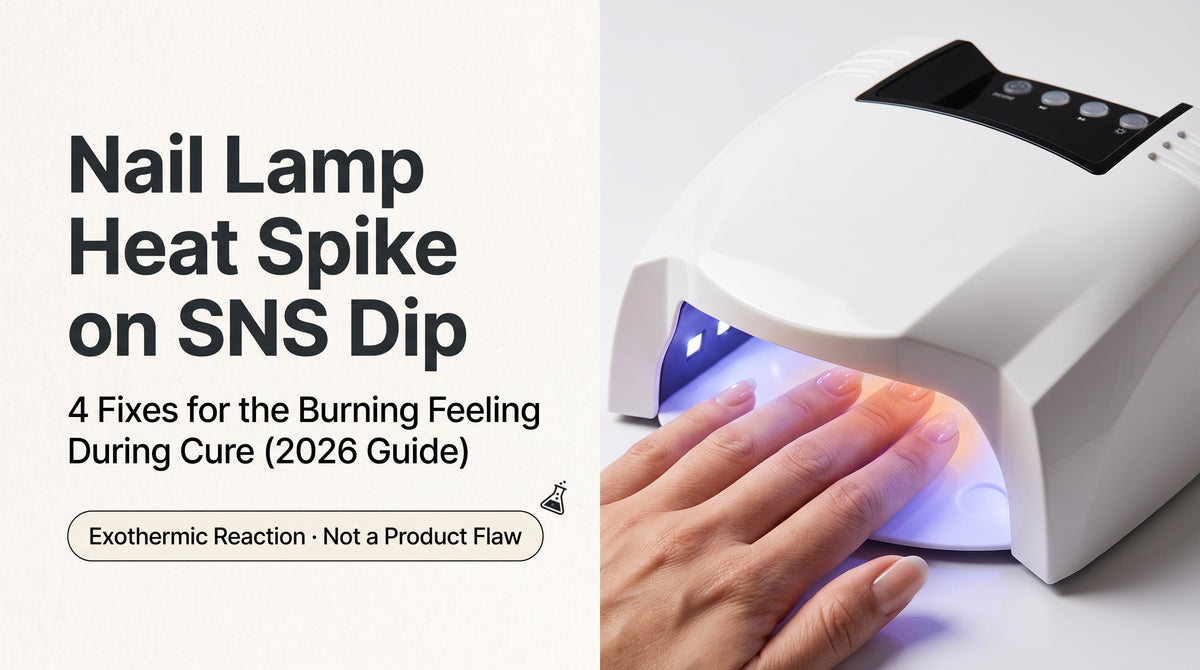
A nail lamp heat spike on your SNS top coat cure is a normal exothermic reaction, not a defective bottle. The intensity is set by how thick you built the layer, not by the SNS brand. Here is why the nail lamp heat spike happens at the 15 to 20 second mark, why you feel it and your friend does not, and the four fixes, three of which cost nothing.
"In seven years of running an SNS salon, the heat-spike calls I get most are always the same story: the user layered the SNS top coat twice as thick as they should have, then blamed the lamp for burning. Splitting the layer into two thin coats with a full cure between them stops the burn in almost every case."
- Your SNS top coat gives off heat as it cures. This is a normal exothermic reaction, not a bad product.
- The thicker the layer, the more chemical bonds form at once, and the more heat concentrates in the same instant.
- Three of the four fixes for a nail lamp heat spike are technique changes with no product cost.
- Switching to a lower-wattage lamp does not fix heat spikes. Splitting the layer does.
- Your nail plate is only about 0.3 mm thick. That is all that separates hot SNS top coat from nerve endings.
Is a Nail Lamp Heat Spike on SNS Supposed to Happen?
The honest answer is yes, up to a point. Any gel or dip top coat gives off heat when it cures because curing is a chemical reaction, and this particular reaction is what chemists call exothermic, meaning it releases energy as heat.
A small amount of warmth during your SNS top coat cure is normal. It is a sign the product is polymerizing correctly. What is not normal is pulling your hand out because the sensation crossed from warmth into sharp pain. The heat is real, but the intensity depends on how you applied the layer, not on the label on the bottle.

What a Nail Lamp Heat Spike Actually Is: The Physics Under the Cure
When the UV or LED light in your nail lamp hits your SNS top coat, small molecules inside the layer start chemically bonding to each other. Each new bond releases a small amount of energy as heat.
In a thin layer, those bonds form over a wide area and the heat spreads out. In a thick layer, many bonds form in the same instant in the same place, and the heat piles up before it can dissipate.
That pile-up is what you feel as a sharp nail lamp heat spike, usually around the 15 to 20 second mark of the cure. If your SNS top coat is applied twice as thick as it should be, the heat spike is not twice as big. It can be several times bigger, because the bonds are concentrated in one small volume with no room to release.
Thicker layer means more bonds forming at once, which means more heat concentrated in the same moment. The cure is doing exactly what it should. There is simply too much of it happening in one place.
One more piece of the mechanism worth naming. Different formulas cure at different reaction rates. Two top coats with the same layer thickness will not always produce the same peak temperature, because the speed at which bonds form controls how tightly the heat packs into the moment.
A fast-reacting formula finishes its bond-making quickly and throws its heat in a shorter, sharper spike. A slower-reacting formula spreads the same total heat over a longer window, and you feel warmth rather than a burn.
Why You Feel the Nail Lamp Heat Spike and Your Friend Doesn't
Your natural nail plate is only about 0.3 millimeters thick. That thin sheet of keratin is the entire buffer between the reacting SNS top coat above and your nail bed below, where the blood supply and nerve endings sit. Heat has nowhere else to go. It travels straight down.
This is why one person may feel a sharp burn under the lamp while a friend using the same SNS bottle at the same wattage feels only warmth. Three groups of DIY users feel a nail lamp heat spike sooner and more intensely than the rest. If you fit into any of these, you are not imagining the pain.
| Your nail type | Why the heat spike lands harder | What to do |
|---|---|---|
| Thin, weak, or ridged natural nails | The 0.3 mm buffer is thinner than average from the start. Your nail bed is closer to the heat source. | Reinforce the plate with a Nutri-Plus base coat before any thick top coat build. Split the top coat into 2 thin layers. |
| Chronic nail biters (onychophagia) | Your plate is thinned by wear and softened by moisture from repeated skin and saliva contact. | Recovery-first approach. Skip the thick build for the first 4-6 weeks of SNS wear. Let the plate rebuild first. |
| Freshly filed or over-filed plate | If you just removed a previous SNS set with an e-file at the highest speed, you filed away part of the plate you were about to build on. | Slow the e-file to 5,000-8,000 RPM on the removal pass. Preserve plate thickness. See how to remove dip powder safely. |

Four Ways to Reduce a Nail Lamp Heat Spike (Three Cost You Nothing)
The reflex when a cure burns is to blame the SNS bottle and buy a different one. That fix is expensive and it rarely works because the burn is not the product. The four fixes below are ordered by cost, cheapest first. If the first three do not solve it, the fourth is a one-time equipment change.
Fix 1 (Free): Split the SNS Top Coat Into Two Thin Layers
This one fix solves 70 to 80 percent of heat spike calls I get. Instead of pouring one thick top coat and curing once, apply half the volume, cure fully, then apply the second half, and cure fully again.
Total time is longer, but total heat is spread across two smaller peaks with a cool-down in between. Neither peak is high enough to hurt.
Fix 2 (Free): Pull Your Hand Out and Reinsert It
The moment you feel warmth starting to cross into heat, pull your hand out of the lamp for one or two seconds and reinsert. That short pause lets the heat that has already built up dissipate into the air before it reaches your nail bed. It also interrupts the reaction peak so the next few seconds of cure start from cooler.
This is a valid technique, not a workaround. You are not weakening the cure. You are controlling the temperature curve while the same total polymerization happens.
Fix 3 (Free): Nail Lamp Low-Heat Mode Reduces the Heat Spike
Most modern LED lamps have a low-heat or gentle-cure mode. It does not cure weaker. It ramps power up gradually rather than firing at full output in the first two seconds. The same total energy hits your SNS top coat, but it is spread across a longer window, so the peak temperature is lower.
Use it on days when your nails feel more sensitive, or whenever a layer is thicker than usual. The limit is worth naming. Low-heat mode softens the temperature curve. It does not send light deeper into the layer. If your SNS top coat is actually too thick to cure to the bottom, low-heat mode will not fix that. Fix 1 will.
Fix 4 (Equipment): Nail Lamp Peak Match Reduces Heat Spike
If you have applied a thin, split, well-cured SNS top coat and still get a heat spike, the problem may be that your lamp is single-peak and your SNS top coat has a photoinitiator tuned to the peak your lamp does not emit.
A single-peak lamp working against the wrong peak wastes energy as heat rather than converting it into cure bonds. A dual-peak lamp (often labeled dual light source or 2-in-1) covers both 365 nm and 405 nm. For a full walk-through of lamp wattage vs peak vs bead count, see our companion LED lamp wattage guide for SNS DIY dip users.

When a Nail Lamp Heat Spike Is a Sign of Under-Cure
Both under-cure and over-cure can present as heat problems, but they look different on the finished nail. The signs below are the ones you can catch yourself, right after you finish curing and before you leave the mirror.
| Signal | Under-cure (heat is a warning) | Correctly cured |
|---|---|---|
| Right after cure | Sharp heat spike during cure, plus surface still feels sticky beyond the normal tacky film. | Brief warmth during cure, then surface is solid to the press test. |
| A few days later | SNS wear appears earlier than the 21 days it should hold. Lift starts at the free edge. | SNS holds the full 21-day wear window. No lifting. |
| Longer-term effect | Uncured ingredients (see HEMA and TPO section) can reach skin over the wear window. | No residual reactive ingredients. The plate is safe. |
The single most useful test is the press test. Right after cure, press one clean fingernail into your SNS top coat surface. If it feels solid and does not dent, the layer cured properly. If it dents even slightly, the core is still soft, which means the heat you felt was accompanied by an incomplete cure. Fix by splitting the layer, not by curing longer.

Why an Under-Cure Nail Lamp Heat Spike Matters for Your Skin (HEMA and TPO)
A nail lamp heat spike that ends in a soft, sticky core is not just a wear problem. It is a skin exposure problem, and it is worth reading this section twice if you do your own SNS at home every 2 to 3 weeks.
When any gel or dip layer under-cures, the chemical reaction does not finish. That means some of the reactive ingredients in the formula are still in the layer, and the part that never reacted is the part that can reach your skin over the 21-day wear window. Two ingredients in particular are worth naming.
- HEMA (hydroxyethyl methacrylate) is a common ingredient in many gel and dip base coats. It is a known contact allergen and skin sensitizer.
- TPO (trimethylbenzoyl diphenylphosphine oxide) is a photoinitiator, the ingredient that catches the light and triggers the cure reaction that produces the heat you feel. TPO is known to irritate skin and eyes.
As of September 2025, the European Union restricted both substances from use in nail cosmetics sold in the EU (EU Regulation 2024/197 amending Annex II of the Cosmetics Regulation, see echa.europa.eu). The United States has not restricted either as of September 2026, but ingredient-panel scrutiny has grown on both sides of the Atlantic.
A working nail tech in a salon contacts uncured monomer every workday for years, which is the highest-exposure end of the risk spectrum. As a DIY user doing your own SNS every 2 to 3 weeks, your exposure is much lower, but it is not zero, and it accumulates over years.
Curing fully is your primary defense. This is the strongest reason to build in thin layers rather than push through a heat spike hoping the layer will cure.
A HEMA-free label does not mean reaction-free. Other acrylates in the formula can trigger the same skin response. Patch-test any new SNS product on the inside of your wrist for 48 hours before a full set if you have ever reacted to a nail product before.
Three Things Not to Do When You Feel a Nail Lamp Heat Spike

The reflex responses when the heat crosses into pain are almost all wrong. Two of them make the problem worse.
- Do not push through and hold your hand in the lamp. The peak is short, but the tissue damage at the peak is not proportional to duration. It is proportional to how hot it got. Pull your hand out.
- Do not switch brands as your first move. In my coaching of 150+ SNS DIY users, about 8 out of 10 heat spike complaints are thickness problems that survive a brand change. You spend money and you still burn.
- Do not turn the lamp off mid-cure and leave the layer partly cured. That is the worst of both worlds. You have heat that already happened and a layer that will now hold uncured reactive ingredients against your skin for the whole wear window.
Pull the hand out of the lamp fully, wait two to three seconds, and reinsert to finish the cure. The layer completes its cure. The peak temperature drops. Nothing is wasted.
Frequently Asked Questions About Nail Lamp Heat Spike on SNS
Why does my SNS top coat cause a nail lamp heat spike burn?
A nail lamp heat spike during SNS top coat cure is a normal exothermic reaction. Every gel or dip top coat releases heat as it polymerizes under the lamp. The intensity is controlled by how thick the layer was applied, not by the SNS brand. A thick top coat concentrates many chemical bonds forming in the same instant, and the heat piles up before it can dissipate. Splitting the top coat into two thin coats with a full cure between them stops the burn in most cases.
Is a nail lamp heat spike dangerous, or just uncomfortable?
At normal SNS cure temperatures with a thin layer, a heat spike is uncomfortable but not dangerous. If the spike is intense enough to cause sharp pain, that is your nail bed warning you that heat is transferring through your 0.3 mm plate faster than it can dissipate. Repeated intense spikes over time can damage the nail bed. Pull your hand out when it hurts, split the layer, and try again with a thinner application.
Does a higher-wattage lamp cause more nail lamp heat spike?
Not directly. Lamp wattage is a power draw number, not a cure heat number. What actually controls the heat spike is how much SNS product is polymerizing at once, which is a function of layer thickness. A high-wattage single-peak lamp can produce less heat spike than a low-wattage dual-peak lamp working on a thick layer with the wrong photoinitiator match. See our LED lamp wattage guide for the full breakdown of what actually decides cure.
Can I use SNS if my natural nails are thin or damaged?
Yes, but the recovery-first rule applies. Skip thick top coat builds for the first 4 to 6 weeks. Use a Nutri-Plus base coat to reinforce the plate. Apply SNS top coat in two thin coats rather than one thick pour. Expect a small warmth spike during cure that stays within comfortable range, and pull your hand out if it crosses.
Should I switch to a no-wipe SNS top coat to reduce heat?
No-wipe top coats are a different chemistry, not a lower-heat chemistry. They skip the tacky-film wipe step, which is convenient, but they polymerize with the same exothermic reaction. If a nail lamp heat spike is a problem for you, the fix is thickness (split the layer) and lamp technique (low-heat mode, hand pull), not switching to a no-wipe top coat.
About the Expert Reviewer
MICHELLE TRAN
SNS Salon Owner · Houston, TX · 7+ years professional SNS experience
Michelle has run an SNS-focused salon in Houston since 2019, serving 200+ clients per month across both salon services and DIY consultation. She reviewed this article for technical accuracy on SNS top coat cure chemistry, the exothermic reaction mechanism, and the asymmetric HEMA and TPO exposure framing for DIY users versus daily-exposure salon workers.
Related SNS DIY Foundation Articles
Nail lamp heat spike is one of five foundation topics every SNS DIY user should know before their next set. The other four cover anatomy, application, removal, and lamp science.
- → Nail Anatomy for SNS Dip Users: 8 Parts to See Before You Apply
- → How to Apply Dip Powder at Home: SNS Full Step-by-Step
- → How to Remove Dip Powder at Home: 6-Step Soak-Off Method
- → LED Lamp Wattage for SNS DIY Dip Users (2026 Guide)
- → Shop SNS Nutri-Plus Base Coat with 6 vitamins (A, E, B5, D3, Calcium, Zinc)
Sources
- European Chemicals Agency (ECHA), EU Regulation 2024/197 amending Annex II of the Cosmetic Products Regulation (EC) No 1223/2009: restrictions on HEMA and TPO in nail cosmetics, effective September 2025. echa.europa.eu
- NAILS Magazine, technical explainers on the exothermic cure reaction, the 0.3 mm nail plate buffer, and thick-versus-thin layer heat physics under LED and UV lamps. nailsmag.com


