

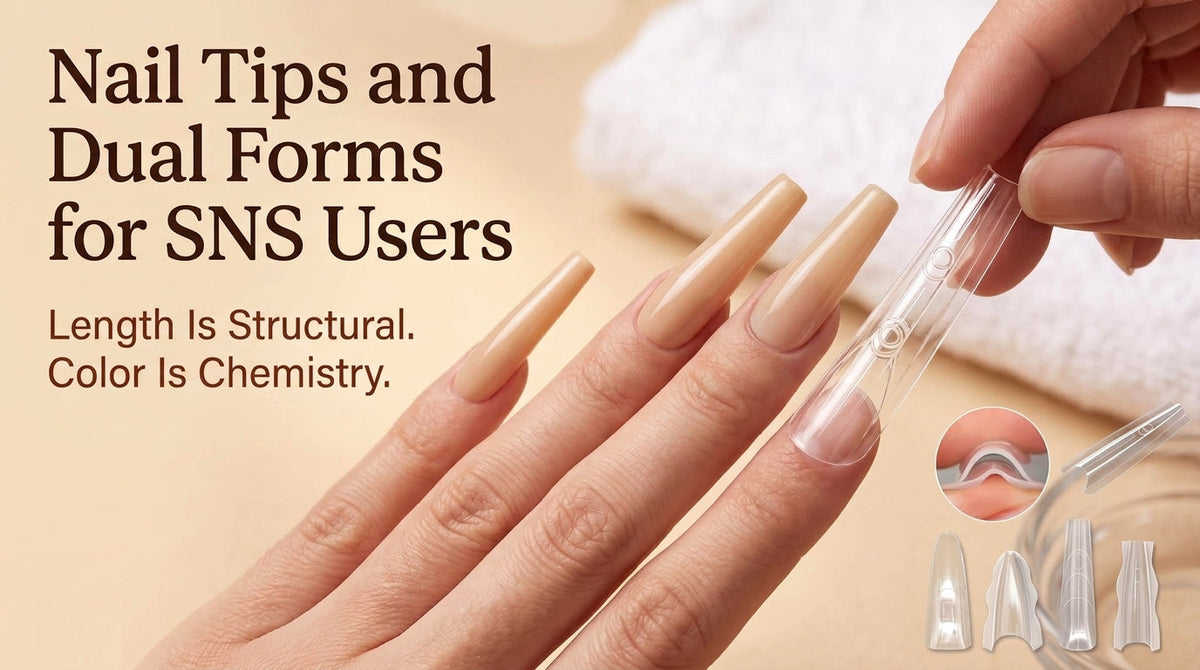
SNS dip powder is a color-and-strength system, not a length system. Its build limit is about 2 mm on the natural plate. If you want longer nails plus SNS color, you add length first with nail tips and dual forms, then apply SNS on top. This guide walks the 4 foundations, when to use nail tips versus dual forms versus Gel X, and the 5 checks that decide day-3 lift.
"About one in four of my SNS clients eventually asks about length. My honest answer is always the same: SNS builds up to 2 mm and no further. If you want more, the length has to come from a tip or a form, and the SNS color goes on afterwards. Skipping this framing sends people down a lot of frustrated home experiments."
- Length comes from the tip or form. Color and strength come from SNS on top.
- Nail tips are pre-shaped plastic. Fit-etch-blend is the workflow, and blending is where most tips fail.
- Gel X refers to full-cover soft gel tips that cure with a light bond, not a glue bond.
- Dual forms are transparent plastic molds you fill with a structural gel, then flip and cure on the nail.
- Five checks decide whether a tip or form stays 21 days: fit, etch, angle, cap, and cure timing.
Nail Tips and Dual Forms Make Length: SNS Makes the Color

The first thing to understand about nail tips and dual forms is what job each part of a long-nail set actually does. Length is a structural job. Color and strength are a chemistry job. Nail tips and dual forms handle the first. SNS dip powder handles the second. Trying to force SNS to do both is where DIY users get frustrated on day 3.
The extra length in a long-nail set can come from four different sources: your natural free edge grown out, a plastic tip glued on, a full-cover soft gel tip (often called Gel X), or a dual form filled with a structural gel and cured directly on the nail. Once the length is in place, an SNS color routine goes over the whole thing exactly like a natural-nail SNS set.
The 4 Extension Foundations: Natural Build, Nail Tips, Gel X, Dual Forms

Here is the honest comparison of the four ways you can end up with longer nails plus SNS color. Each has a different DIY difficulty and a different failure mode.
| Foundation | How length is added | DIY difficulty | Fits SNS color on top? |
|---|---|---|---|
| Natural free-edge growth | Grow your nails, add SNS color on top up to 2 mm build | Easy | Yes. Ideal SNS routine. |
| Plastic nail tips | Pre-shaped plastic glued to free edge, blended, SNS color on top | Medium | Yes, if you blend the tip smoothly. |
| Gel X (full-cover soft gel tips) | Full-cover soft gel tip bonded with a gel adhesive, cured under lamp, SNS color on top | Medium-high | Yes, once cured. |
| Dual forms | Structural gel poured into transparent form, flipped onto nail, cured, form peeled off, SNS color on top | High | Yes, once shaped. |
Length is the tip or form. Color is SNS on top. Do not mix the two jobs in one product.
3 Jobs Structural Gel Does When Working With Nail Tips and Dual Forms
When length comes from a tip or a form, a small amount of structural gel (sometimes called builder gel or extension gel in salon shorthand) usually plays one of three roles between the tip and the SNS color layer.
Job 1: Bonder Between Plastic Nail Tips and Natural Plate (Below Dual Forms)
A thin layer of structural gel or nail glue seals the plastic tip onto the natural nail plate. This is the primary hold. If this bond fails, no amount of SNS on top will save the tip. Nail glue is the most common home tool. Structural gel is used when the fit needs a flexible bond that will not snap under impact.
Job 2: Overlay to Blend Nail Tips Edge Into Natural Plate
After the plastic tip is glued, the join line between plastic and natural nail is a step. A thin overlay of structural gel fills that step and files smooth, so the SNS color layer on top has a flat surface to grip. Without this blend step, the join line telegraphs through the SNS color, and the tip catches on things and lifts.
Job 3: Structure Inside Dual Forms for Nail Tips Extensions
For dual forms specifically, the structural gel fills the whole extension shape inside the transparent form. When cured and released, that gel IS the extension. SNS color then goes over the top like any natural-nail SNS set. This is the highest-difficulty option and the one most home users start with wrong.
Can You Use Structural Gel as Nail Glue for Plastic Nail Tips and Dual Forms?
Short answer: yes for a home DIY set, no for a set that has to hold under heavy use. Structural gel cures under a lamp and creates a flexible bond, which is why plastic nail tips bonded with structural gel handle impact better than tips bonded with hard cyanoacrylate nail glue.
The tradeoff is speed. Nail glue sets in 5 to 10 seconds and lets you shape immediately. Structural gel needs a 30 to 60 second lamp cure and you cannot move the tip during that window. For a full 10-nail DIY set, nail glue is faster. For 1 or 2 tips that need to survive daily use, structural gel is the safer choice.
Working With Plastic Nail Tips: Fit, Etch, Blend

Plastic nail tips are the most beginner-friendly length option for SNS DIY users. The workflow is fit, etch, blend. Skipping any of the three is where most home tip sets fail.
- Fit: hold the tip against the nail. It should cover the full width of the free edge without spilling over the side walls. If it is too wide, size down. If it hangs over, size down.
- Etch: lightly buff the inside of the tip where it meets the plate. This gives the glue or bond gel something to grip. Skip this step and the tip pops off cleanly on day 2.
- Blend: after gluing, file the join line at the top of the tip so the transition from natural nail to plastic is invisible. This is where 80 percent of home tip sets fail.
Run your fingernail across the join line. If you feel a step, the blend is not done. Keep filing with 180-grit until the join reads as a single smooth surface. Only then apply SNS over the top.
Full-Cover Soft Gel Nail Tips: What People Call Gel X (SNS Compatible)
Full-cover soft gel tips (commonly called Gel X in the DIY community, after the brand that made the category popular) are a hybrid between a traditional plastic tip and an overlay. The tip is a soft, flexible plastic that covers the entire nail from cuticle to free edge, not just the extension.
The bond is a gel adhesive that cures under an LED lamp, not a cyanoacrylate glue. This is why the hold feels different: it is chemical, not mechanical. Removal is a full acetone soak like a gel-polish set, not a snap-off like a glued plastic tip.
For an SNS user, the appeal is speed. A full-cover soft gel tip gives you the entire length and shape in one press-fit step, so the SNS color routine that follows is simpler. The tradeoff is cost: full-cover soft gel tips cost more per set than plastic nail tips.
Nail Tips vs Gel X vs Acrylic: Which Extension for SNS Users

SNS users looking at length have three realistic paths. Here is the honest comparison focused on DIY practicality, not marketing.
| Factor | Plastic nail tips | Gel X (soft gel tips) | Acrylic extension |
|---|---|---|---|
| DIY difficulty | Medium (fit-etch-blend) | Medium (press-fit + lamp cure) | High (liquid + powder + shaping) |
| Time for 10 nails (first-timer) | 60-90 minutes | 45-75 minutes | 90-120 minutes |
| Fits SNS color on top | Yes | Yes | Yes |
| Removal | Snap off + soak | Acetone soak 20-30 min | Acetone soak 30-40 min + file |
| Best for | Everyday length + SNS color | Fastest DIY long-nail set | Long-lasting salon-look sets |
Dual Forms Technique: Slide Nail Tips In, Never Press Down
Dual forms are the highest-skill length option in this guide, and they are worth the learning curve if you want a custom C-curve and a shape that looks salon-made. A dual form is a transparent plastic mold shaped like a nail. You fill the form with a structural gel, slide the form onto your natural nail from the tip inward, cure under a lamp, and peel the form off.
The single most important rule for dual forms is technique. Slide the form onto the nail from the tip toward the cuticle. Do not press the form straight down onto the nail. Pressing down traps air bubbles between the form and the natural plate, and those bubbles cure into permanent voids that lift the whole extension within days.
Slide it in, never press it down. This one rule saves 80 percent of home dual-form sets. If the form does not slide cleanly, the fit is wrong. Try a smaller size before forcing it.
5 Checks Before You Cure Nail Tips or Dual Forms

Curing locks whatever position the tip or form is in. Once cured, the only way to change the position is to remove and restart. These 5 checks take 20 seconds each and prevent the most common home tip mistakes.
| Check | What to look for | If wrong, do this |
|---|---|---|
| Fit | Tip or form covers full width, no overhang at side walls | Size down. Do not force a wide tip into a narrow bed. |
| Etch | Inside of tip is buffed matte, not glossy | Buff again. Glossy tip = weak bond. |
| Angle | Tip sits at the natural nail's continuation angle, not tilted up or down | Reset the angle before curing. Tilted tip = catches on everything. |
| Cap | Free edge of the extension is capped by the bond gel or top coat | Cap the tip. Uncapped free edge chips within 3 days. |
| Cure timing | Lamp is ready, and you can hold the position for the full cure | If you flinch, redo it. Half-cured position is worse than none. |
Why Do Nail Tips Lift Early on Dual Forms (And How to Fix Each Cause)
Nail tips that lift within 3 to 7 days almost always trace back to one of four causes. Each has a specific fix at a specific step, so once you know which cause you are hitting, you do not need to redo the whole set.
| Lift symptom | Root cause | The fix |
|---|---|---|
| Whole tip pops off cleanly, glue side smooth | Did not etch the inside of the tip | Buff the inside of every tip matte before gluing. |
| Tip lifts at cuticle side first | Plastic tip pushed too far onto the natural plate | Position the tip to cover only the extension zone, not the whole nail. |
| Small crack line at the tip join | Blend was incomplete, or SNS color went on before the join was smooth | File the join to a single smooth surface before SNS color. |
| Free-edge chip within days | Did not cap the SNS top coat over the tip | Cap the free edge on the SNS top coat step, every nail. |
French Manicure With Dual Forms and Nail Tips: Let the Form Make the Smile Line
Dual forms have a lesser-known advantage for French manicure sets: the form itself creates the smile line for you. Instead of drawing the French curve by hand with a thin brush, you fill the form with a white or cream structural gel, then fill the rest with a clear or nude structural gel, then cure. The line between the two colors is set by how you loaded the form, which is a much more forgiving technique than hand-drawing.
For SNS DIY users who want a French look without the drawn-line skill, this is the highest-ROI application of dual forms. Cured extension carries the French line. SNS clear top coat locks the whole thing.
HEMA and TPO Safety Notes for Nail Tips and Dual Forms Systems
Any system that uses reactive gel ingredients (structural gel for tip bonding, gel X adhesives, gel-filled dual forms, and every SNS top coat) has a safety conversation involving two ingredients: HEMA and TPO.
- HEMA (hydroxyethyl methacrylate) is a common ingredient in many gel adhesives and structural gels. It is a known skin sensitizer. Repeated exposure over years can trigger contact allergy.
- TPO (trimethylbenzoyl diphenylphosphine oxide) is a photoinitiator that triggers the cure reaction. TPO is known to irritate skin and eyes.
As of September 2025, the European Union restricted both substances from use in nail cosmetics sold in the EU (EU Regulation 2024/197 amending Annex II of the Cosmetics Regulation, see echa.europa.eu). The United States and United Kingdom have not restricted either as of September 2026.
For DIY tip and form work, the safety rule is simple: keep gel adhesive and structural gel off skin. Wipe any product that lands on the cuticle or sidewall before curing. Patch test any new bottle if you have ever reacted to a nail product before.
A HEMA-free label does not guarantee reaction-free. Other acrylates in gel adhesives can trigger the same skin response. Patch-test.
Frequently Asked Questions About Nail Tips and Dual Forms for SNS Users
Can I apply SNS dip powder over plastic nail tips?
Yes. Glue the tips first, blend the join line smoothly with a 180-grit file, then apply the SNS routine on top exactly like a natural-nail SNS set. The nail tips provide length. SNS provides color and strength. The join between them is where most sets fail, so blend carefully. See how to apply SNS dip powder for the full routine.
Can I apply SNS dip powder over Gel X full-cover tips?
Yes. Once the Gel X tips are fully cured and shaped, treat them like natural nails for the SNS routine. Prep, Nutri-Plus base, dip, activator, top coat cure. The full-cover soft gel surface accepts SNS color well because it is chemically compatible with the SNS base coat cyanoacrylate family.
How long do nail tips last with SNS color on top?
A well-fitted, well-blended plastic tip with SNS color on top holds the same 21-day wear window as a natural-nail SNS set. Poor fit or a rushed blend cuts wear to 5 to 10 days. Fit-etch-blend is the discipline that decides the wear window.
Do I need a full lamp for dual forms if I only use SNS?
Yes. The dual form step needs an LED lamp to cure the structural gel inside the form. A small handheld lamp is not enough for a full form pour. Once the extension is cured and released from the form, your regular SNS top coat step uses a small handheld lamp as usual. See our LED lamp wattage guide for lamp choice.
Are dual forms hard for a first-time DIY user?
Honestly, yes. Dual forms are the highest-skill option in this guide. If you are new to extension work, start with plastic nail tips (fit-etch-blend) or Gel X (press-fit). Come back to dual forms after you are comfortable with those two.
About the Expert Reviewer
MICHELLE TRAN
SNS Salon Owner · Houston, TX · 7+ years professional SNS experience
Michelle has run an SNS-focused salon in Houston since 2019, serving 200+ clients per month across salon services and DIY consultation. She reviewed this article for accuracy on how plastic tips, Gel X, and dual forms pair with an SNS color routine, and for the fit-etch-blend workflow that determines whether a home tip set survives its 21-day wear.
Related SNS DIY Foundation Articles
This extension companion pillar rounds out an 8-article SNS DIY Foundation Series.
- → What Is SNS Dip Powder? A DIY User's Complete Guide
- → How to Apply SNS Dip Powder at Home: 8-Step Guide
- → SNS Dip Powder Thickness Guide: How to Avoid a Bulky Look
- → Nail Anatomy for SNS Dip Users: 8 Parts to See Before You Apply
- → How to Remove Dip Powder at Home: 6-Step Soak-Off Method
- → Nail Lamp Heat Spike on SNS Dip: 4 Fixes
Sources
- European Chemicals Agency (ECHA), EU Regulation 2024/197 amending Annex II of the Cosmetic Products Regulation (EC) No 1223/2009: restrictions on HEMA and TPO in nail cosmetics, effective September 2025. echa.europa.eu
- NAILS Magazine, technical explainers on plastic nail tips, full-cover soft gel tips (Gel X category), dual form sculpting technique, and cyanoacrylate resin bonding for extension systems. nailsmag.com


