

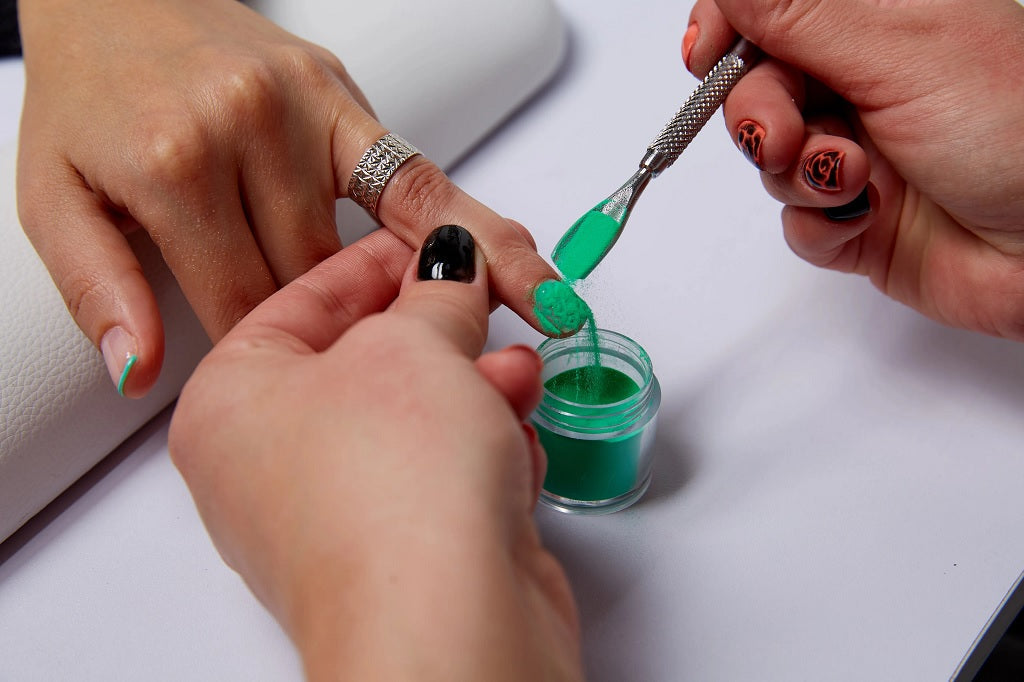
Dip powder sits at the center of a long-running debate about nail damage. Here is what the chemistry actually does, where the myths come from, and the daily routine that keeps a dip set working.
Dip powder has been one of the most-asked-about nail services in recent years, with questions divided between women who are enthusiastic about the wear time and durability and women who are concerned that the method damages the natural nail underneath. Both reactions trace back to real experiences; neither answer applies uniformly across every woman and every application. The article below works through the three common myths that generate most of the concern, then names the four benefits that make dip powder a reasonable choice for a specific set of circumstances, and closes with the daily routine that distinguishes a dip set that serves the wearer well from one that leaves her natural nails worse than when she started.
The underlying principle to carry across the whole article: dip powder is a system that works when the application and removal discipline are respected and that produces damage when either side of that discipline is skipped. The method itself is neither inherently harmful nor inherently nourishing. What matters is how the system is used.
Understanding Dip Powder: What It Actually Is Chemically
A dip powder manicure sits on the natural nail as a layered coating made from an acrylic resin base coat, a colored polymer powder applied by dipping the nail into a jar of pigmented powder, and an activator layer that converts the stack into a hard set. Several coats of base-and-powder build the thickness, and a final sealant produces the glossy finish. The result is a coating that bonds to the natural plate through the chemistry of the base coat and holds a hard outer layer through the chemistry of the powder and activator working together.
Wear time for a well-applied dip set typically falls in the range of three to four weeks, longer than most gel polish services and comparable to acrylic in daily durability. The chemistry sits closer to acrylic than to gel polish, but the two systems are not the same. Dip and acrylic share the powder: both are built on methacrylate polymer beads. What differs is the liquid that binds those beads together. A dip base coat is a cyanoacrylate resin that sets as it meets the powder and the activator, while acrylic uses a methacrylate monomer that polymerizes when it is mixed with the powder on the brush. The shared polymer powder is why a finished dip set feels structurally similar to an acrylic set; the different binding liquid is why dip applies without a lamp and without the monomer odor of an acrylic service, and why components from the two systems should not be substituted for each other.
Takeaway
Dip powder is a cyanoacrylate-plus-polymer coating system. It wears like acrylic and applies without a lamp. The chemistry itself is the context for both the benefits and the myths that follow.
Three Common Myths and the Reality Behind Each
Most hesitation around dip powder traces back to one of three recurring claims. Each one has a kernel of truth that explains why the myth persists, and each one has a specific reality that the myth misses.
| The myth | Where it comes from | What the reality actually is |
|---|---|---|
| Dip powder weakens nails. | Clients who had bad experiences with aggressive filing during removal, or who peeled off their own sets, found their nails thinner afterward. | The weakening came from the removal technique, not from the dip powder itself. Proper soak-off removal preserves the natural plate. |
| Dip powder is unhygienic. | Traditional salon practice involved multiple clients dipping into a single powder jar, which raised legitimate hygiene concerns. | Modern salons use individual-portion jars or pour-over techniques that eliminate the shared-jar exposure path. Home application sidesteps the issue entirely. |
| Dip powder contains harmful chemicals. | Older formulations of some nail products contained dibutyl phthalate, toluene, and formaldehyde (collectively called the Toxic Trio in older cosmetic literature). | Specific product-category chemistry choices exclude these ingredients and others. Reading the ingredient list on the product in hand is the way to verify what any specific line excludes. |
Myth 1: Dip Powder Weakens Nails
The pattern that produced this myth is real. Women who removed their dip sets by filing aggressively or by peeling the coating off in frustration found their natural nails visibly thinner afterward. The visible thinning led the clients to blame the dip powder itself when the actual culprit was the removal technique.
“My friend blamed dip for her thinning nails. I avoided dip for three years because of it. Then I watched her peel a set off between appointments. The dip was fine; her removal shortcut was pulling layers of plate off every time.”
The prevention sits in two places. The first is prep: a prepped nail plate with the surface shine removed, dehydrated with a dedicated prep solution such as LAVIS Nail Prep PH Bond, and coated with a thin layer of a dip-specific base such as SNS Dip Base Coat creates a bond that holds through the full wear cycle without lifting prematurely. Early lifting is what tempts the wearer to peel. The second is removal: a soak-off in acetone with the appropriate wrap or soaking bowl, followed by gentle pushing of the softened material off the plate, preserves the natural nail. Aggressive filing and peeling are what cause the thinning that gets blamed on the product.
Myth 2: Dip Powder is Unhygienic
The hygiene concern was legitimate in its original context. Shared powder jars in salon settings created a transmission pathway between clients, and the pathway was difficult to clean between appointments because the powder environment itself resisted standard sanitation.
The industry response was twofold. Many salons now use individual-portion powder jars that go with the client, eliminating the shared-container exposure. Other salons use the pour-over method, where the powder is poured over the nail from the jar rather than dipping the nail into the jar, which keeps the jar itself untouched. Home application removes the concern entirely because the user is the only person touching the jar.
Myth 3: Dip Powder Contains Harmful Chemicals
The ingredient-safety concern around nail products in general traces back to older formulations that contained dibutyl phthalate, toluene, and formaldehyde, which collectively earned the industry nickname of the Toxic Trio in cosmetic literature. Current formulations differ widely across manufacturers, and the only reliable way to verify what any specific product contains or excludes is to read the ingredient list on the product in hand.
For women who have been specifically identified by a dermatologist as sensitized to particular monomers in gel polish, two product-category chemistry choices worth knowing are the A’DOR Signature 144 HEMA-Free collection and the A’DOR Color Me Gel-Ons HEMA-Free sets, both of which list HEMA-free and TPO-free formulation on their product descriptions. Women who have been identified as sensitized can match that ingredient profile to the specific monomer they are avoiding. The HEMA-free positioning is not a universal safety guarantee; it is a specific chemistry choice relevant to specific clinical situations.
For dip powder specifically, HEMA and TPO belong to the UV-cured gel chemistry rather than to the cyanoacrylate-and-powder chemistry a dip set is built from, so neither ingredient is part of a standard dip stack. The ingredient awareness still carries across the broader category of nail products the woman is using, including the gel polish services that often accompany dip powder work.
Four Benefits That Make Dip Powder a Reasonable Choice
Dip powder has become popular because the system delivers specific advantages that other services cannot match in the same combination. The four benefits below are what the method actually offers; whether each one matters depends on the individual wearer and her priorities.
Benefit 1: Long-Lasting Wear
A properly applied dip powder set holds between three and four weeks of normal daily use without chipping or peeling, which exceeds the typical two-week wear interval of a standard gel polish and matches the interval of a well-applied acrylic set. For women whose work or lifestyle makes frequent nail appointments impractical, the extended wear interval is often the single reason to choose dip powder over the alternatives.
Benefit 2: Added Structural Support for Weak Nails
The layered construction of a dip set adds thickness and rigidity to the natural plate underneath, which protects weak or brittle nails from the mechanical stress of daily use while the natural plate recovers from whatever caused the weakening. For women rebuilding from a period of breakage, the dip powder set functions as a protective exoskeleton that holds the natural nail in place while it grows back.
The structural benefit compounds when the dip stack sits on top of a protective base coat that bonds cleanly to the natural plate. LAVIS Gel Polish Base Coat applied in a thin even layer before the dip powder adheres cleanly to the natural nail and gives the full coating stack its structural foundation; the base coat prevents lifting at the cuticle, which is where the mechanical stress of daily use tends to find weakened spots first. Sealing the top of the stack with LAVIS Gel Polish Diamond Top Coat adds a hard outer layer that absorbs the mechanical stress of daily use before that stress reaches the natural plate underneath. The two-coat sandwich around the dip powder itself extends the protective interval between appointments and reduces how often the natural plate is exposed to removal cycles.
“My nails split at the free edge for a year before I tried dip. The LAVIS Gel Polish Base Coat sandwich with LAVIS Gel Polish Diamond Top Coat sealing it gave me three weeks of protected wear per cycle. Four months of back-to-back sets, and the splitting pattern stopped. The dip held the plate while it recovered.”
Benefit 3: Shade Variety and Finish Range
The dip powder category covers a wider shade range than most other service types because the powder-based formulation accommodates a range of pigment loads and particle sizes that produce effects a liquid polish cannot replicate directly. Catalogs across major manufacturers typically run into the hundreds of shades per line, which allows wardrobe-level variety across a wear cycle that lasts several weeks per set.
Benefit 4: Quick Set and Return to Normal Hand Use
Unlike traditional nail polish that requires air drying, dip powder sets within the application process itself and returns the wearer to normal hand use as soon as the top coat has dried, which usually happens within a few minutes of application. The absence of a drying window at the end of the appointment eliminates the smudging risk that often ruins a traditional polish application in the first hour after the appointment.
How to Choose Dip Powder Products Thoughtfully
Dip powder product selection matters because the home user has less margin for product-side problems than a professional technician does. The dimensions that separate dip powder product lines from each other are grind consistency of the powder, formulation of the base coat, formulation of the activator or sealing step, and the presence or absence of specific chemistries that affect sensitization risk for women with known sensitivities.
The practical shortcut for a first-time home user is to buy a complete starter kit from a single manufacturer rather than mixing components across brands. The components within a single system are formulated to work with each other; mixing a base coat from one brand with an activator from another produces unpredictable results because the chemistries were not designed to interact. Once the user has worked through one full system and understands what she likes and does not like, individual replacement bottles become a reasonable move.
For the specific question of what distinguishes a product system suited to home use from one suited to professional salon use, the honest answer is that the systems differ mostly in powder particle size and base coat working window rather than in overall safety or quality. Home-user-oriented systems typically have longer base coat working windows that give the first-time dipper more time to build the hand-timing of the full workflow; professional systems typically have faster-setting formulations that match the pace of salon appointment flow. Both work well for their intended user.
Proper Application and Removal Protocols That Protect the Natural Nail
The myths covered earlier in this article mostly trace back to shortcuts in either application or removal, and the detailed protocol for each stage sits in a dedicated article on the topic. For the full set of application mistakes that drive the common failure patterns, see the common mistakes to avoid when applying dip powder nails, which covers prep, layer thickness, activator timing, and buffing discipline. For the removal side, how to safely remove dip powder at home walks through the soak-off sequence step by step.
The short version of the application rule: thin even layers at every step, with tap-and-brush discipline after each dip, and no shortcuts on the prep sequence. The short version of the removal rule: soak off in acetone with the appropriate wrap or soaking bowl, then push the softened coating off the plate gently rather than filing or peeling. These two rules together prevent most of the damage patterns that get blamed on dip powder itself.
A Daily Nail Care Routine for Dip Powder Wearers
The dip powder set lives on top of the natural nail, and the natural nail still responds to the same daily care that it would need without any coating on top. A set that holds its wear interval well sits on a natural plate that is kept hydrated and healthy underneath; a set that lifts prematurely often sits on a plate that has become dry and brittle during the wear cycle.
A worked daily routine for dip powder wearers runs on three levels. SNS Signature Serum applied at the cuticle each morning delivers conditioning to the nail matrix, where new growth is produced. A cuticle oil applied before bed works on the plate overnight, when the hand is at rest and the oil has time to penetrate without being washed off. A hand cream applied several times across the day, especially after any water or chemical contact, prevents the overall hand drying that otherwise reaches the nails indirectly. Each step targets a different layer of the hand-and-nail system, and running all three in combination produces more visible improvement than relying on any single one.
For the broader context of nail breakage and the hydration mechanisms behind each cause, see why nails keep breaking and the daily routine that lets weak nails rebuild. The routine described there applies equally well to dip powder wearers and to women not wearing any coating at all.
Takeaway
A dip set lives on top of the natural plate. The daily hydration routine underneath determines how well that plate holds up through the removal cycle and into the next set.
When to Seek Professional Help
Home dip powder application is accessible once the workflow is understood, and most women who put in the practice time can produce a wearable result after a few sets. The professional nail technician still adds value in specific situations: when the natural plate is already damaged and needs expert assessment before a coating is applied; when the client has specific sensitization concerns that require careful product selection; or when the preferred wear time or finish complexity is beyond what the home kit can reliably deliver.
For women who are considering dip powder but have never had the service before, booking a single salon appointment to see the full workflow in person is often worth more than reading three articles on the topic. The salon appointment reveals pacing details and tool handling details that the written description can only approximate, and the resulting home practice sits on a foundation of direct observation rather than on text alone.
Frequently Asked Questions
Does dip powder actually damage the natural nail?
Not when the application and removal protocols are respected. The damage pattern that gives dip powder its reputation traces to aggressive filing during removal, peeling off sets between appointments, or skipping prep steps that lead to premature lifting. Proper soak-off removal and careful prep leave the natural plate as healthy as it was before the dip set went on.
What specific ingredients should I look for in dip powder products?
Ingredient lists are the only reliable reference. Historically the three ingredients that drew the most attention in cosmetic literature were dibutyl phthalate, toluene, and formaldehyde. For women with specific sensitivities identified by a dermatologist, the A’DOR Signature 144 HEMA-Free collection and the A’DOR Color Me Gel-Ons HEMA-Free sets both list HEMA-free and TPO-free formulation, which matters for women specifically sensitized to those monomers.
Can dip powder actually strengthen weak nails rather than weaken them further?
Yes, when the dip set is used as a protective coating over a prepped natural plate. The layered construction adds structural rigidity that protects the plate underneath from the mechanical stress of daily use. Combined with a base coat such as LAVIS Gel Polish Base Coat and a top coat such as LAVIS Gel Polish Diamond Top Coat around the dip stack, the full coating protects the natural nail while it grows back from the matrix.
How often should I apply cuticle oil when I am wearing dip powder?
Once or twice daily is the practical baseline. SNS Signature Serum applied at the cuticle each morning, a cuticle oil applied before bed, and a hand cream applied several times across the day together form a three-level routine that keeps the natural plate underneath the dip set hydrated through the full wear cycle.
Should I take biotin supplements to improve my nail health?
A healthcare provider is the right person to answer that question for an individual case. Biotin supplementation can affect certain blood tests and is worth discussing with a doctor rather than starting independently. If a specific deficiency is suspected, a blood panel with a provider is a more reliable guide to supplementation than general internet recommendations.


